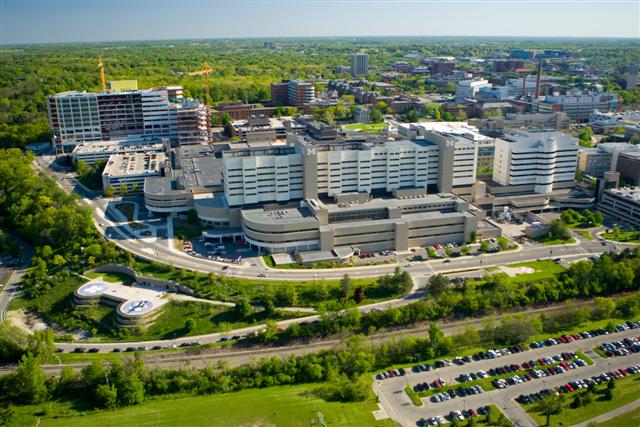
University of Michigan University Hospital (Ann Arbor). This hospital’s history dates back to 1869, when the University of Michigan opened the nation’s first university-owned hospital, which had 20 beds. The hospital has changed drastically throughout its nearly 150-year history, and now the 550-bed University Hospital is one of three hospitals that make up U-M Medical Center. The other two are C.S. Mott Children’s Hospital and the Von Voigtlander Women’s Hospital. In total, U-M’s three hospitals have 1,059 pediatric, adult and psychiatric beds and six specialty centers, focused on cancer, cardiovascular health, diabetes, depression, geriatrics and eye health.
U-M is home to many medical firsts. For instance, University Hospital offered the first physician training program in thoracic surgery in 1928 and, four years later, hosted the world’s first successful lung removal. In 1968, the hospital hosted Michigan’s first heart transplant.
More recently, in February 2015, the Joyce and Don Massey Family Foundation Emergency Critical Care Center opened inside University Hospital’s emergency department. The new center is among the first of its kind in the U.S. and features five resuscitation/trauma bays and nine patient rooms that provide an intensive care unit-level environment for initial care.
Last year, U-M Health System research funded by external sources grew to $417.6 million, a 2.7 percent increase from 2014. According to U.S. News & World Report’s 2015-16 rankings, U-M’s University Hospital is the No. 1 hospital in the state and is nationally ranked in 11 adult specialties.
 |
 |