
August/September 2026 Issue of Becker’s Clinical Leadership & Infection Control
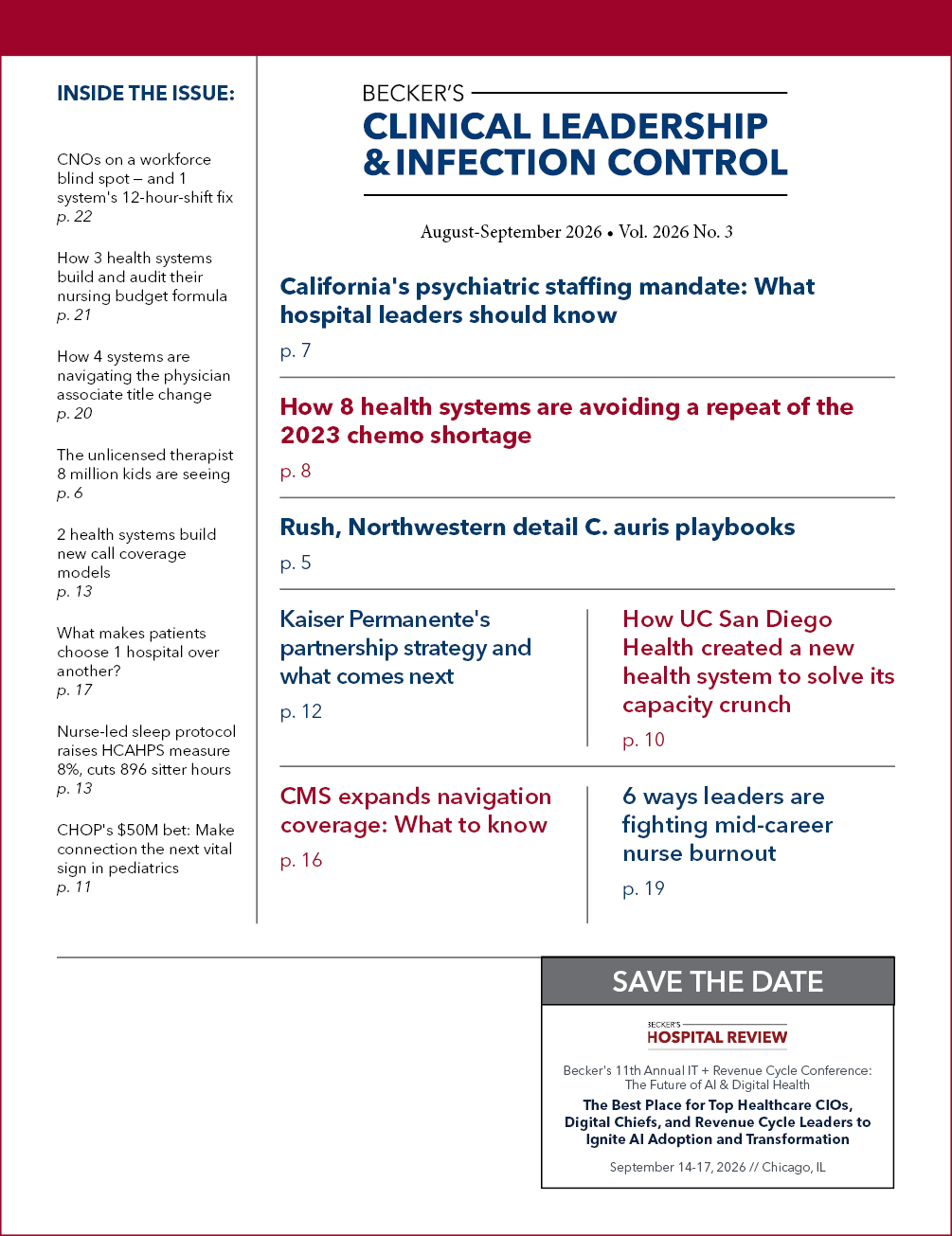
On Cover
California’s psychiatric staffing mandate: What hospital leaders should know
California’s new emergency nurse-to-patient staffing ratios for acute psychiatric hospitals took effect June 1, closing a regulatory gap that had left freestanding psychiatric facilities without mandated minimums for more than two decades. But leaders are raising concerns about behavioral healthcare access and workforce turnover.
How 8 health systems are avoiding a repeat of the 2023 chemo shortage
Chemotherapy drugs cisplatin, carboplatin, oxaliplatin and ifosfamide are in shortage again, but five health systems are managing without the treatment delays and drug rationing that defined 2023.
Rush, Northwestern detail their playbooks for C. auris
In medicine, “interesting” is rarely a compliment. So when Mary Hayden, MD, describes Candida auris as one of the most interesting organisms she’s encountered in her career, it’s not praise — it’s a warning.
Kaiser Permanente’s partnership strategy and what comes next
Oakland, Calif.-based Kaiser Permanente has spent 81 years building an integrated care model that consistently outperforms national benchmarks on cancer mortality, cardiovascular disease and overall premature death. For most of that history, experiencing that model meant being a Kaiser member in a Kaiser market. Shelby DeCosta, senior vice president and chief business development officer, is focused on changing that.
How UC San Diego Health created a new health system to solve its capacity crunch
When University of California San Diego Health leaders looked ahead, they saw a problem that couldn’t be solved simply by adding more patients or expanding existing programs.
CMS expands navigation coverage: What to know
For CMS’ 2026 final rule, the agency broadened who can bill Medicare for patient navigation services. While the agency’s reimbursement pathway is still less than three years old, U.S. health systems have used patient navigators to help people move through complex, high-stakes diagnoses for decades.
6 ways leaders are fighting mid-career nurse burnout
Mid-career nurses, defined as those with five to 15 years of experience, are now the most burned-out group, a finding that comes as no surprise to nurse leaders.
3 CNOs on a workforce blind spot — and 1 system’s 12-hour-shift fix
Most health systems have rules meant to keep fatigue in check: caps on consecutive shifts, minimum rest between them, limits on overtime. But those safeguards stop at a single employer’s walls. When a nurse hits the ceiling at one hospital and picks up a per diem shift at another, no scheduling system on either side sees the combined hours.
How 3 health systems build and audit their nursing budget formula
Nursing workforce planning formulas may carry a structural error embedded since at least 1960, one that has quietly caused hospitals to systematically underbudget nursing staff across decades of textbooks, credentialing programs and government frameworks. The finding raised a pointed question for health system leaders: how confident can you be that your own nursing budget formula is producing the right number?
How 4 systems are navigating the physician associate title change
Six states have adopted the physician associate title, and hospitals in those states are in different stages of using the title internally.
The unlicensed therapist 8 million kids are seeing
Nearly 1 in 5 adolescents and young adults in the U.S. — an estimated 8.2 million people — used an AI chatbot for mental health advice in 2025, according to a study published June 1 in JAMA Pediatrics. The findings are stark: 91.7% rated the guidance as somewhat or very helpful, and 42.8% came back at least monthly. But 63.3% never told a parent, friend or other trusted adult they were doing it.
2 health systems build new call coverage models
Hospitals across the country are finding that traditional call coverage models are no longer enough. Clearwater, Fla.-based BayCare Health System and Midland-based MyMichigan Health are reworking the formula.
What makes patients choose 1 hospital over another?
Most patients decide on a hospital before settling on a physician — or land on both in the same step — when they first encounter a new health concern, according to survey results U.S. News & World Report published July 20.
Nurse-led sleep protocol raises HCAHPS measure 8%, cuts 896 sitter hours
A nurse-driven inpatient sleep protocol raised Hospital Consumer Assessment of Healthcare Providers and Systems nighttime quietness scores 8.47% and reduced sitter hours by 896 over seven months, according to a study published June 23 in Cureus.
CHOP’s $50M bet: Make connection the next vital sign in pediatrics
Children’s Hospital of Philadelphia is betting the bond between a parent and child can be observed as reliably as blood pressure and taught to tens of thousands of clinicians nationwide.
Patient safety and outcomes
Rush, Northwestern detail their playbooks for C. auris
In medicine, “interesting” is rarely a compliment. So when Mary Hayden, MD, describes Candida auris as one of the most interesting organisms she’s encountered in her career, it’s not praise — it’s a warning.
The unlicensed therapist 8 million kids are seeing
Nearly 1 in 5 adolescents and young adults in the U.S. — an estimated 8.2 million people — used an AI chatbot for mental health advice in 2025, according to a study published June 1 in JAMA Pediatrics. The findings are stark: 91.7% rated the guidance as somewhat or very helpful, and 42.8% came back at least monthly. But 63.3% never told a parent, friend or other trusted adult they were doing it.
California’s psychiatric staffing mandate: What hospital leaders should know
California’s new emergency nurse-to-patient staffing ratios for acute psychiatric hospitals took effect June 1, closing a regulatory gap that had left freestanding psychiatric facilities without mandated minimums for more than two decades. But leaders are raising concerns about behavioral healthcare access and workforce turnover.
How 8 health systems are avoiding a repeat of the 2023 chemo shortage
Chemotherapy drugs cisplatin, carboplatin, oxaliplatin and ifosfamide are in shortage again, but five health systems are managing without the treatment delays and drug rationing that defined 2023.
Quality improvement & measurement
How UC San Diego Health created a new health system to solve its capacity crunch
When University of California San Diego Health leaders looked ahead, they saw a problem that couldn’t be solved simply by adding more patients or expanding existing programs.
CHOP’s $50M bet: Make connection the next vital sign in pediatrics
Children’s Hospital of Philadelphia is betting the bond between a parent and child can be observed as reliably as blood pressure and taught to tens of thousands of clinicians nationwide.
Kaiser Permanente’s partnership strategy and what comes next
Oakland, Calif.-based Kaiser Permanente has spent 81 years building an integrated care model that consistently outperforms national benchmarks on cancer mortality, cardiovascular disease and overall premature death. For most of that history, experiencing that model meant being a Kaiser member in a Kaiser market. Shelby DeCosta, senior vice president and chief business development officer, is focused on changing that.
2 health systems build new call coverage models
Hospitals across the country are finding that traditional call coverage models are no longer enough. Clearwater, Fla.-based BayCare Health System and Midland-based MyMichigan Health are reworking the formula.
Nurse-led sleep protocol raises HCAHPS measure 8%, cuts 896 sitter hours
A nurse-driven inpatient sleep protocol raised Hospital Consumer Assessment of Healthcare Providers and Systems nighttime quietness scores 8.47% and reduced sitter hours by 896 over seven months, according to a study published June 23 in Cureus.
Patient and caregiver experience
‘Return on humanity’: The measure that explains what ROI can’t
Amid financial pressures, it’s easy for leaders to rely solely on return on investment as the primary measure for success, but for Frantz Berthaud, “return on humanity” is just as important to measure.
The hospitals that feature a movie theater for patients
In Britain, nine hospitals have a movie theater inside their facilities for patients to watch the latest blockbusters, The New York Times reported July 8.
CMS expands navigation coverage: What to know
For CMS’ 2026 final rule, the agency broadened who can bill Medicare for patient navigation services. While the agency’s reimbursement pathway is still less than three years old, U.S. health systems have used patient navigators to help people move through complex, high-stakes diagnoses for decades.
What makes patients choose 1 hospital over another?
Most patients decide on a hospital before settling on a physician — or land on both in the same step — when they first encounter a new health concern, according to survey results U.S. News & World Report published July 20.
When patients see cancer diagnoses via EHR: 5 notes
Among patients who learned of their cancer diagnosis through an online portal, 59% were alone at the time, according to a study published June 24 in JAMA Network Open.
Clinical leadership
6 ways leaders are fighting mid-career nurse burnout
Mid-career nurses, defined as those with five to 15 years of experience, are now the most burned-out group, a finding that comes as no surprise to nurse leaders.
How 4 systems are navigating the physician associate title change
Six states have adopted the physician associate title, and hospitals in those states are in different stages of using the title internally.
How 3 health systems build and audit their nursing budget formula
Nursing workforce planning formulas may carry a structural error embedded since at least 1960, one that has quietly caused hospitals to systematically underbudget nursing staff across decades of textbooks, credentialing programs and government frameworks. The finding raised a pointed question for health system leaders: how confident can you be that your own nursing budget formula is producing the right number?
3 CNOs on a workforce blind spot — and 1 system’s 12-hour-shift fix
Most health systems have rules meant to keep fatigue in check: caps on consecutive shifts, minimum rest between them, limits on overtime. But those safeguards stop at a single employer’s walls. When a nurse hits the ceiling at one hospital and picks up a per diem shift at another, no scheduling system on either side sees the combined hours.
