
October 2026 Issue of Becker’s Hospital Review
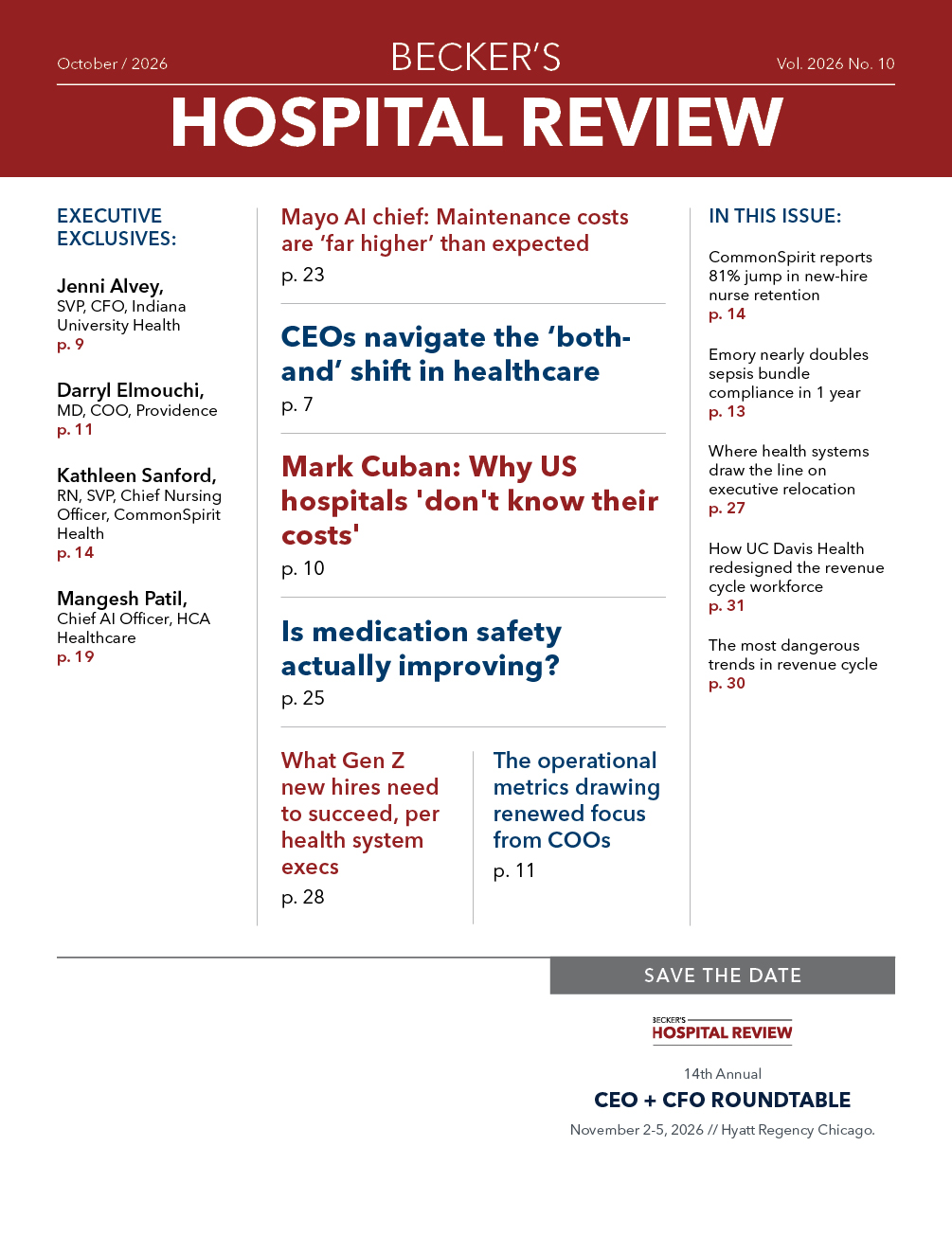
On The Cover
Jenni Alvey, SVP, CFO, Indiana University Health
“In today’s healthcare environment, we must continue to evolve and plan for the unexpected.” That quote from Jenni Alvey, senior vice president and CFO of Indianapolis-based Indiana University Health, in the system’s second quarter results is one that might resonate with many finance leaders – forcing them to split thinking between expected versus unexpected.
Darryl Elmouchi, MD, COO, Providence
Ask COOs and other strategic leaders which operational metric matters most right now, and the answers span a wide range: length of stay, patient throughput, transfer acceptance rates, facility utilization, workforce retention, access. But a common thread runs underneath: With physician shortages tightening access and margins under sustained pressure, leaders can no longer simply add capacity to fix a problem. That has pushed many health systems to get more disciplined about the capacity, space and people they already have, and to treat their chosen metric less as a standalone number to hit and more as a proxy for how well the whole organization is running.
Kathleen Sanford, RN, SVP, Chief Nursing Officer, CommonSpirit Health
Chicago-based CommonSpirit Health has achieved an 81% jump in new-hire nurse retention over the past year, alongside double-digit reductions in registered nurse turnover and resignation rates.
Mangesh Patil, Chief AI Officer, HCA Healthcare
Executives across healthcare are tasked with crafting, deploying and scaling AI strategies and tools at their hospitals and health systems, with the goal of easing clinician burnout and improving patient outcomes.
Mayo AI chief: Maintenance costs are ‘far higher’ than expected
Mayo Clinic has moved well beyond AI pilots. Now it is learning what it costs to keep AI running at scale.
CEOs navigate the ‘both-and’ shift in healthcare
When William “Bill” Robertson, CEO of Tacoma, Wash.-based MultiCare Health System, described how his organization grew into the largest community-based health system in the Pacific Northwest over 12 years, he credited three cultural principles. Among them is what he calls “both-and thinking” — the belief that a health system can pursue more than one priority at a time.
Mark Cuban: Why US hospitals ‘don’t know their costs’
Mark Cuban argues the fundamental problem in U.S. healthcare is not whether the system is run by the public sector or the private sector. It is that hospitals do not know what their own services cost.
Is medication safety actually improving?
Medication safety has drawn renewed national scrutiny after Ascension St. Thomas Hospital Midtown in Nashville, Tenn., confirmed that four joint replacement patients were mistakenly injected with potassium phosphate instead of the anesthetic mepivacaine Aug. 14.
What Gen Z new hires need to succeed, per health system execs
As Generation Z takes up a growing share of the healthcare workforce, health system leaders are putting greater focus on helping early-career employees build the interpersonal skills, connections and career pathways they need to succeed.
The operational metrics drawing renewed focus from COOs
Ask COOs and other strategic leaders which operational metric matters most right now, and the answers span a wide range: length of stay, patient throughput, transfer acceptance rates, facility utilization, workforce retention, access. But a common thread runs underneath: With physician shortages tightening access and margins under sustained pressure, leaders can no longer simply add capacity to fix a problem. That has pushed many health systems to get more disciplined about the capacity, space and people they already have, and to treat their chosen metric less as a standalone number to hit and more as a proxy for how well the whole organization is running.
CommonSpirit reports 81% jump in new-hire nurse retention
Chicago-based CommonSpirit Health has achieved an 81% jump in new-hire nurse retention over the past year, alongside double-digit reductions in registered nurse turnover and resignation rates.
Emory nearly doubles sepsis bundle compliance in 1 year
When LeWanza Harris, MD, chief quality officer of Atlanta-based Emory Healthcare, dug deeper into the system’s sepsis data last year, the metrics told a story of fragmentation across the system’s 11 hospitals.
Where health systems draw the line on executive relocation
Health system executives who keep a primary residence in one city and travel to another for work are not a new phenomenon. But as systems recruit nationally, expand across state lines and compete for high-level talent, where an executive is expected to live can become a factor in a search.
UC Davis Health redesigned the revenue cycle workforce
For years, the measure of a medical coder was throughput. How many charts are processed? How fast? How accurately? That productivity frame is giving way to a more strategic approach at UC Davis Health in Sacramento, Calif.
The most dangerous trends in revenue cycle
Ask a Revenue Cycle Leader is a new series featuring insights from health system and hospital revenue cycle executives nationwide. Becker’s poses questions on the most pressing issues in healthcare finance — from payer relations and automation to workforce and patient experience. We welcome responses from all revenue cycle, finance and reimbursement leaders.
CEO Strategy
CEOs navigate the ‘both-and’ shift in healthcare
When William “Bill” Robertson, CEO of Tacoma, Wash.-based MultiCare Health System, described how his organization grew into the largest community-based health system in the Pacific Northwest over 12 years, he credited three cultural principles. Among them is what he calls “both-and thinking” — the belief that a health system can pursue more than one priority at a time.
What a physician revolt taught Scripps’ CEO
Every health system CEO has a defining leadership experience and Scripps president and CEO Chrs Van Gorder’s happened years ago at an Orange County-based hospital he joined as a vice president.
CFO Finance
What the ‘unexpected’ looks like to IU Health’s CFO
“In today’s healthcare environment, we must continue to evolve and plan for the unexpected.” That quote from Jenni Alvey, senior vice president and CFO of Indianapolis-based Indiana University Health, in the system’s second quarter results is one that might resonate with many finance leaders – forcing them to split thinking between expected versus unexpected.
Mark Cuban: Why US hospitals ‘don’t know their costs’
Mark Cuban argues the fundamental problem in U.S. healthcare is not whether the system is run by the public sector or the private sector. It is that hospitals do not know what their own services cost.
COO
The operational metrics drawing renewed focus from COOs
Ask COOs and other strategic leaders which operational metric matters most right now, and the answers span a wide range: length of stay, patient throughput, transfer acceptance rates, facility utilization, workforce retention, access. But a common thread runs underneath: With physician shortages tightening access and margins under sustained pressure, leaders can no longer simply add capacity to fix a problem. That has pushed many health systems to get more disciplined about the capacity, space and people they already have, and to treat their chosen metric less as a standalone number to hit and more as a proxy for how well the whole organization is running.
Clinical Leadership
Emory nearly doubles sepsis bundle compliance in 1 year
When LeWanza Harris, MD, chief quality officer of Atlanta-based Emory Healthcare, dug deeper into the system’s sepsis data last year, the metrics told a story of fragmentation across the system’s 11 hospitals.
CommonSpirit reports 81% jump in new-hire nurse retention
Chicago-based CommonSpirit Health has achieved an 81% jump in new-hire nurse retention over the past year, alongside double-digit reductions in registered nurse turnover and resignation rates.
Banner cuts nurse documentation task from 100-plus clicks to fewer than 10
Phoenix-based Banner Health has cut the number of clicks a nurse needs to document a routine physical exam from more than 100 to fewer than 10 — without buying new technology.
CIO / HEALTH IT
Mayo AI chief: Maintenance costs are ‘far higher’ than expected
Mayo Clinic has moved well beyond AI pilots. Now it is learning what it costs to keep AI running at scale.
Who’s minding the machines? CIOs raise concerns about AI agent oversight
Health systems have spent years rolling out AI tools that draft notes, summarize charts, and answer patient messages. The next wave is different: AI agents that can take actions on their own — placing orders, flagging results, closing gaps in documentation — without a person approving each step.
PHARMACY
Is medication safety actually improving?
Medication safety has drawn renewed national scrutiny after Ascension St. Thomas Hospital Midtown in Nashville, Tenn., confirmed that four joint replacement patients were mistakenly injected with potassium phosphate instead of the anesthetic mepivacaine Aug. 14.
How a 12-hospital system saved millions with an inventory overhaul
Pittsburgh-based Allegheny Health Network has saved $4.2 million and significantly reduced medication stockouts after shifting from managing pharmacy inventory at individual hospitals to an enterprisewide strategy, according to Laura Mark, PharmD, vice president of pharmacy.
CHRO
Where health systems draw the line on executive relocation
Health system executives who keep a primary residence in one city and travel to another for work are not a new phenomenon. But as systems recruit nationally, expand across state lines and compete for high-level talent, where an executive is expected to live can become a factor in a search.
What Gen Z new hires need to succeed, per health system execs
As Generation Z takes up a growing share of the healthcare workforce, health system leaders are putting greater focus on helping early-career employees build the interpersonal skills, connections and career pathways they need to succeed.
RCM Leader
The most dangerous trends in revenue cycle
Ask a Revenue Cycle Leader is a new series featuring insights from health system and hospital revenue cycle executives nationwide. Becker’s poses questions on the most pressing issues in healthcare finance — from payer relations and automation to workforce and patient experience. We welcome responses from all revenue cycle, finance and reimbursement leaders.
UC Davis Health redesigned the revenue cycle workforce
For years, the measure of a medical coder was throughput. How many charts are processed? How fast? How accurately? That productivity frame is giving way to a more strategic approach at UC Davis Health in Sacramento, Calif.
