
September 2026 Issue of Becker’s Hospital Review
On The Cover
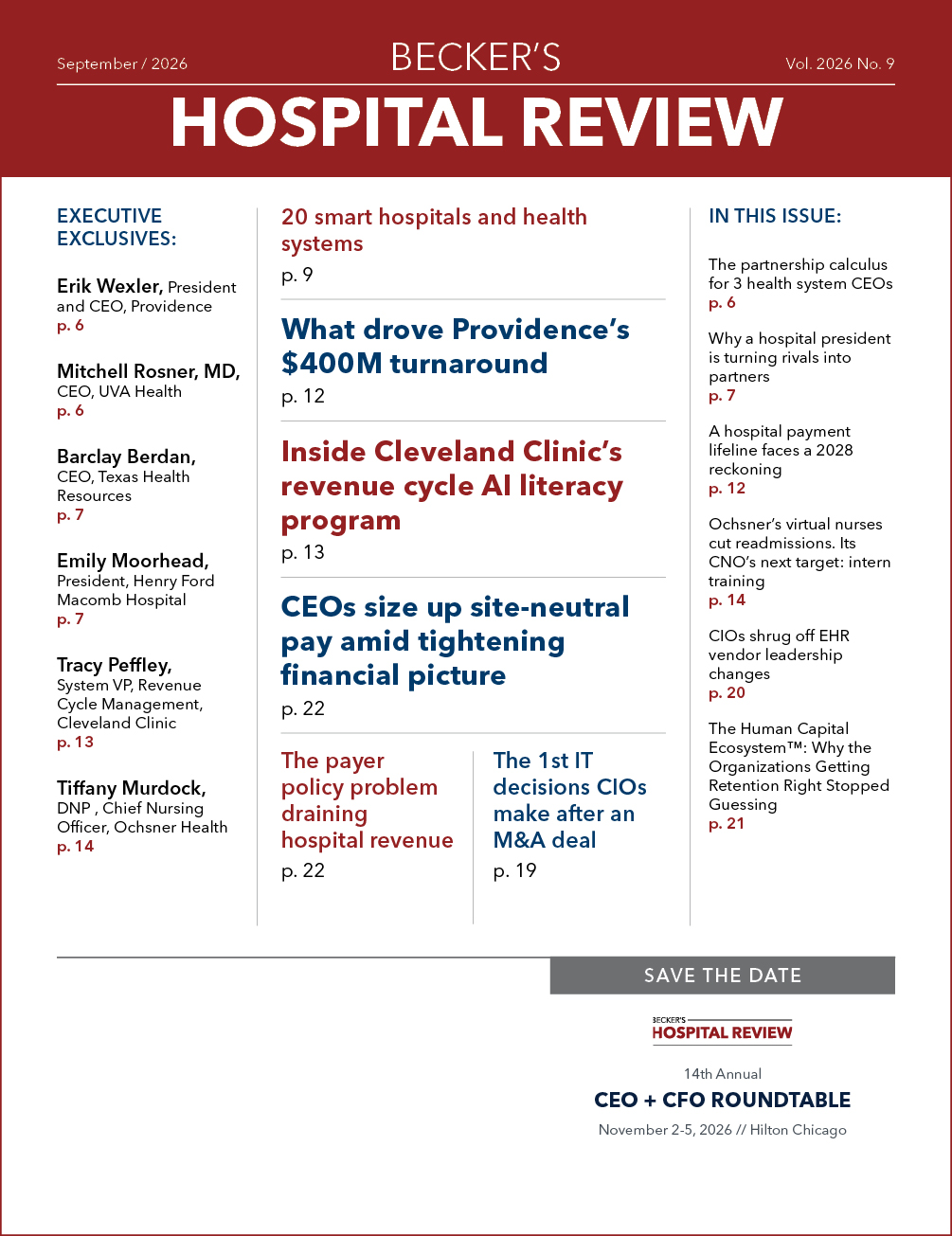
Erik Wexler, President and CEO, Providence
Health systems have long turned to partnerships to expand services, add capabilities and extend their reach. But the decision to partner rather than build or expand a service independently can depend on a range of factors, from specialized expertise and capital to patient volume and market needs.
Mitchell Rosner, MD, CEO, UVA Health
Health systems have long turned to partnerships to expand services, add capabilities and extend their reach. But the decision to partner rather than build or expand a service independently can depend on a range of factors, from specialized expertise and capital to patient volume and market needs.
Barclay Berdan, CEO, Texas Health Resources
Health systems have long turned to partnerships to expand services, add capabilities and extend their reach. But the decision to partner rather than build or expand a service independently can depend on a range of factors, from specialized expertise and capital to patient volume and market needs.
Emily Moorhead, President, Henry Ford Macomb Hospital
Emily Moorhead, president of the Macomb market at Detroit-based Henry Ford Health, spent her first year building a foundation — strengthening quality metrics, deepening physician partnerships and improving financial performance. The growth question she’s now putting to her leadership team doesn’t start with service lines or market share. She knows the Macomb market can’t serve every community need on its own, and trying to is a mistake.
Tracy Peffley, System VP, Revenue Cycle Management, Cleveland Clinic
AI adoption in healthcare has often outpaced the workforce’s comfort with it, and revenue cycle departments, where automation touches coding, denials and prior authorization daily, are no exception.
Tiffany Murdock, DNP , Chief Nursing Officer, Ochsner Health
New Orleans-based Ochsner Health has run some form of virtual nursing for more than 15 years. Its chief nursing officer said the model is only starting to reshape how care is delivered.
20 smart hospitals and health systems
A smart hospital uses interconnected technologies such as AI, the internet of things and digital platforms to automate workflows, improve patient outcomes, and reduce costs across clinical and management systems.
What’s driving Providence’s $400M turnaround
Renton, Wash.-based Providence has now sustained more than a year of positive operating margin, and executives say the improvement is being driven by a sustained set of operational changes across the system.
‘We don’t want people afraid’: Inside Cleveland Clinic’s revenue cycle AI literacy program
AI adoption in healthcare has often outpaced the workforce’s comfort with it, and revenue cycle departments, where automation touches coding, denials and prior authorization daily, are no exception.
CEOs size up site-neutral pay amid tightening financial picture
Health system CEOs are navigating a growing list of financial pressures, including Medicaid coverage and reimbursement changes under HR 1 and ongoing payment and policy challenges surrounding the federal 340B drug discount program. Site-neutral payment adds another consideration as health systems weigh where to invest and deliver care.
The payer policy problem draining hospital revenue: 6 things to know
Payer policy changes that are not reflected in contracts are the leading source of revenue leakage for providers, according to a July 29 report from Trek Health in partnership with the Healthcare Financial Management Association.
The 1st IT decisions CIOs make after an M&A deal
When a hospital merger closes, one veteran CIO reaches for the exact same playbook every time, while another insists no two acquisitions ever call for the same one.
The partnership calculus for 3 health system CEOs
Health systems have long turned to partnerships to expand services, add capabilities and extend their reach. But the decision to partner rather than build or expand a service independently can depend on a range of factors, from specialized expertise and capital to patient volume and market needs.
Why a hospital president is turning rivals into partners
Emily Moorhead, president of the Macomb market at Detroit-based Henry Ford Health, spent her first year building a foundation — strengthening quality metrics, deepening physician partnerships and improving financial performance. The growth question she’s now putting to her leadership team doesn’t start with service lines or market share. She knows the Macomb market can’t serve every community need on its own, and trying to is a mistake.
A hospital payment lifeline faces a 2028 reckoning
Medicaid supplemental payment programs served as a financial cushion for for-profit health systems in the second quarter as the loss of enhanced ACA premium tax credits pushes more patients into uninsured status.
Ochsner’s virtual nurses cut readmissions. Its CNO’s next target: intern training
New Orleans-based Ochsner Health has run some form of virtual nursing for more than 15 years. Its chief nursing officer said the model is only starting to reshape how care is delivered.
CIOs shrug off EHR vendor leadership changes
EHR vendors have seen a wave of significant leadership changes in recent years, most recently a string of executive departures at Epic. Health system CIOs say none of it is likely to change how they run their organizations day to day — though some argue the risk isn’t spread evenly across vendors, and that Epic’s depth insulates it in a way smaller EHR companies may not.
The Human Capital Ecosystem™: Why the Organizations Getting Retention Right Stopped Guessing
Two decades ago, we in healthcare conducted employee surveys annually (or even bi-annually) to gauge what we called “employee satisfaction.” As the thinking about satisfaction evolved (and we replaced less-useful questions on the survey like “parking” with more-useful questions like “my boss cares about me as a person”), we moved from “satisfaction” to “engagement.”
CEO Strategy
The partnership calculus for 3 health system CEOs
Health systems have long turned to partnerships to expand services, add capabilities and extend their reach. But the decision to partner rather than build or expand a service independently can depend on a range of factors, from specialized expertise and capital to patient volume and market needs.
Why a hospital president is turning rivals into partners
Emily Moorhead, president of the Macomb market at Detroit-based Henry Ford Health, spent her first year building a foundation — strengthening quality metrics, deepening physician partnerships and improving financial performance. The growth question she’s now putting to her leadership team doesn’t start with service lines or market share. She knows the Macomb market can’t serve every community need on its own, and trying to is a mistake.
CFO Finance
What’s driving Providence’s $400M turnaround
Renton, Wash.-based Providence has now sustained more than a year of positive operating margin, and executives say the improvement is being driven by a sustained set of operational changes across the system.
A hospital payment lifeline faces a 2028 reckoning
Medicaid supplemental payment programs served as a financial cushion for for-profit health systems in the second quarter as the loss of enhanced ACA premium tax credits pushes more patients into uninsured status.
‘We don’t want people afraid’: Inside Cleveland Clinic’s revenue cycle AI literacy program
AI adoption in healthcare has often outpaced the workforce’s comfort with it, and revenue cycle departments, where automation touches coding, denials and prior authorization daily, are no exception.
Clinical Leadership
Ochsner’s virtual nurses cut readmissions. Its CNO’s next target: intern training
New Orleans-based Ochsner Health has run some form of virtual nursing for more than 15 years. Its chief nursing officer said the model is only starting to reshape how care is delivered.
CIO / HEALTH IT
The 1st IT decisions CIOs make after an M&A deal
When a hospital merger closes, one veteran CIO reaches for the exact same playbook every time, while another insists no two acquisitions ever call for the same one.
CIOs shrug off EHR vendor leadership changes
EHR vendors have seen a wave of significant leadership changes in recent years, most recently a string of executive departures at Epic. Health system CIOs say none of it is likely to change how they run their organizations day to day — though some argue the risk isn’t spread evenly across vendors, and that Epic’s depth insulates it in a way smaller EHR companies may not.
RCM Leader
CEOs size up site-neutral pay amid tightening financial picture
Health system CEOs are navigating a growing list of financial pressures, including Medicaid coverage and reimbursement changes under HR 1 and ongoing payment and policy challenges surrounding the federal 340B drug discount program. Site-neutral payment adds another consideration as health systems weigh where to invest and deliver care.
The payer policy problem draining hospital revenue: 6 things to know
Payer policy changes that are not reflected in contracts are the leading source of revenue leakage for providers, according to a July 29 report from Trek Health in partnership with the Healthcare Financial Management Association.
