
Ask a health system CIO which of their peers does technology best, and most have an answer ready. Ask them to size up their own budgets against the industry, or to name the executive title healthcare could live without, and the answers get more revealing.
Becker’s emailed the CIOs and chief digital officers, or their equivalents, at the 200 largest U.S. health systems by annual revenue over the past month. Twenty-five responded to a seven-question survey. Because responses were collected anonymously and Becker’s does not publish anonymous quotes, the results are reported in aggregate.
Respondents could name more than one answer per question, were not barred from naming their own organizations and could skip questions.
Here is what they said:
1. Which health system does technology best?
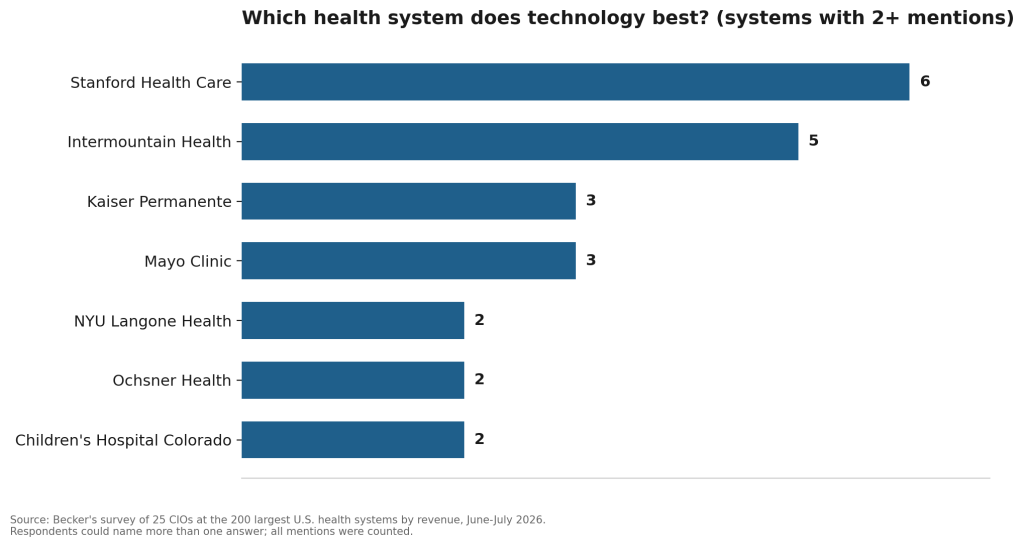
Palo Alto, Calif.-based Stanford Health Care was the most-mentioned system, named by six of the 25 respondents, followed by Salt Lake City-based Intermountain Health with five mentions. Oakland, Calif.-based Kaiser Permanente and Rochester, Minn.-based Mayo Clinic drew three mentions apiece, while New York City-based NYU Langone Health, New Orleans-based Ochsner Health and Aurora-based Children’s Hospital Colorado each drew two.
Nineteen other organizations received one mention each: Advocate Health (Charlotte, N.C.); Baptist Health (Jacksonville, Fla.); Cedars-Sinai (Los Angeles); Children’s Healthcare of Atlanta; Children’s Hospital of Philadelphia; Cleveland Clinic; CommonSpirit Health (Chicago); Duke Health (Durham, N.C.); FMOL Health (Baton Rouge, La.); Houston Methodist; Inova Health System (Fairfax, Va.); Mount Sinai Health System (New York City); Northeast Georgia Health System (Gainesville); Northwestern Medicine (Chicago); Ohio State University Wexner Medical Center (Columbus); St. Luke’s University Health Network (Bethlehem, Pa.); Sutter Health (Sacramento, Calif.); UPMC (Pittsburgh); and UT Southwestern Medical Center (Dallas).
What earned a system a mention was rarely the newest technology. Respondents repeatedly credited the same qualities: maturity, disciplined execution, the ability to scale beyond pilots and a habit of measuring whether technology actually improves patient care, workforce experience and operations. Five respondents declined to name anyone at all, with several arguing that “best” is meaningless apart from a system’s mission, patient population and outcomes.
2. Which health system IT leader do you admire most?
Michael Pfeffer, MD, chief information and digital officer of Stanford Health Care, was named more often than any other leader. Others drawing multiple mentions were Shakeeb Akhter, who became chief digital officer of New York City-based Memorial Sloan Kettering Cancer Center in May after leading digital and technology at Children’s Hospital of Philadelphia; Daniel Barchi, senior executive vice president and CIO of CommonSpirit Health; Myra Davis, executive vice president and chief information and innovation officer of Houston-based Texas Children’s; and Laura Wilt, chief digital officer of Sutter Health.
Respondents also praised Andy Crowder of Advocate Health; Richard “Dick” Daniels, the former CIO of Kaiser Permanente; Mike Dozier of Singing River Health System (Ocean Springs, Miss.); Alistair Erskine, MD, of Highmark Health (Pittsburgh); Amy Feaster of Children’s Hospital Colorado (Aurora); Matt Kull of Inova Health System; Novlet Mattis of Orlando (Fla.) Health; Aaron Miri, DHA, of Baptist Health; Heather Nelson of Boston Children’s Hospital; Neal Patel, MD, of Vanderbilt University Medical Center (Nashville, Tenn.); Cris Ross, who retired as CIO of Mayo Clinic in 2024; Shane Thielman of Scripps Health (San Diego); and Jim Whitfill, MD, of HonorHealth (Scottsdale, Ariz.).
CIOs singled out peers with the discipline to quietly build high-performing organizations, those who pair innovation with operational rigor, and those who treat technology as enterprise transformation rather than a support function. More than one respondent said the leaders they most admire are the ones making a difference for patients without seeking recognition.
3. Which C-level technology role is least necessary these days?
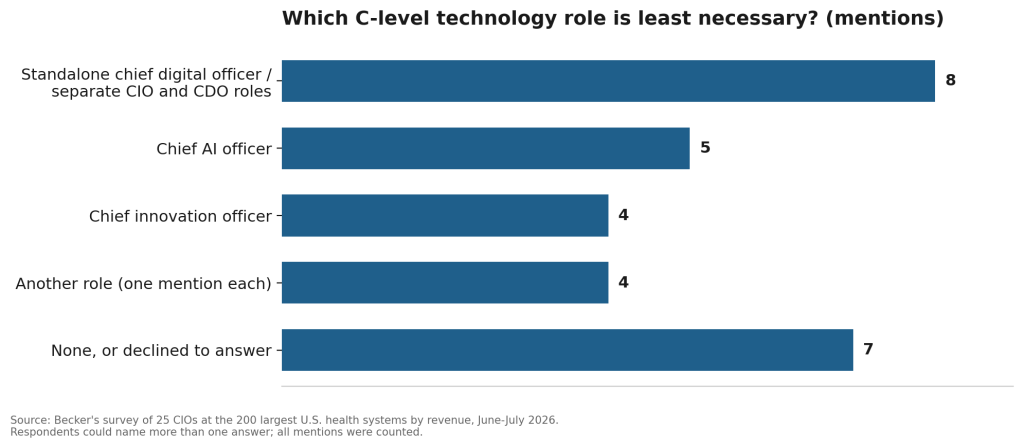
The standalone chief digital officer took the most fire. Eight respondents said either that the role should not exist apart from IT operations or that the CIO and chief digital officer should be a single job — with some arguing digital has become inseparable from core technology, data and operations. Five named the chief AI officer, and four the chief innovation officer. The chief transformation officer, chief strategy officer, chief data officer and COO each drew one mention.
Seven respondents declined to answer or said no technology role is inherently unnecessary — though even several of those framed the real problem as siloed leadership with overlapping mandates rather than any particular title. The through line was convergence: Respondents repeatedly argued organizations need one accountable technology leader connected to enterprise strategy, not a lengthening bench of chiefs.
4. How much does your health system spend on IT?
Disclosed budgets ranged from roughly $82 million to $850 million in annual operating spend, and from 2.43% to about 5% of total expenses. The answers arrived on inconsistent bases — some respondents combined capital and operating dollars, others cited operating budgets alone, and several gave only percentages measured against different denominators — so the figures resist a clean side-by-side comparison. One respondent declined to share numbers at all, arguing the industry fixates on the wrong question: how much is spent, rather than what the spending returns in outcomes, resiliency and adoption.
The more telling pattern was self-assessment. Of the respondents who benchmarked their own spending, only a handful characterized it as above industry standards; the rest placed themselves at or below. In an industry where nearly every system describes itself as investing aggressively in technology, almost no one believes they are outspending their peers.
5. How many people staff your IT department?
Reported headcounts ranged from 365 to 1,850 full-time equivalents, and here too most respondents placed themselves at or below benchmarks for organizations of their size. Several attached the same caveat: Headcount is becoming a less meaningful measure as AI, automation, managed services and platform consolidation change the relationship between staffing levels and capability. A few noted that a growing share of the work now sits with external partners rather than on the internal roster, and that the better question is whether a system has the right mix of technical, cybersecurity, data and digital talent — not how many badges it issues.
6. What is the most overhyped trend in healthcare IT?
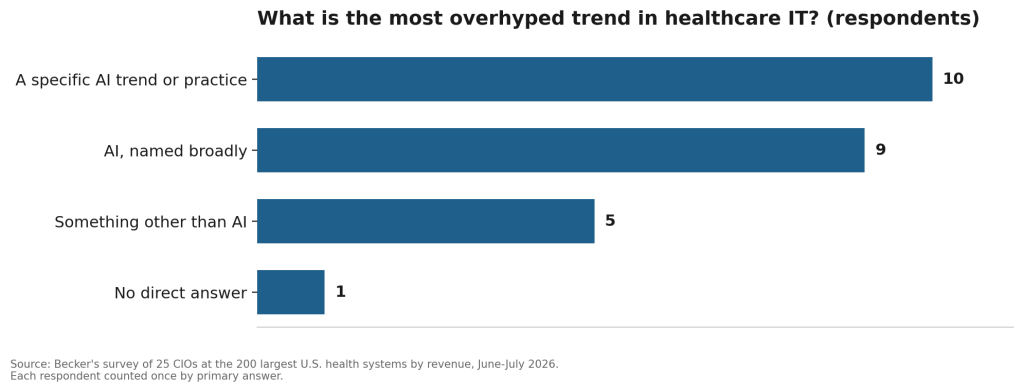
AI — in one form or another. Nineteen of the 25 respondents pointed to AI or a specific application of it. Nine named AI broadly. Ten singled out a particular flavor: unproven pilots, generative AI deployments without operational redesign, fully autonomous agents, homegrown models built while vendor tools sit unadopted, AI governance itself, ambient documentation, standalone tools that don’t integrate with the EHR, autonomous triage and the habit of labeling every product AI. Other answers included: large ERP implementations, the digital front door, smart rooms, blockchain and big data.
The nuance matters. Very few respondents dismissed the technology itself. The recurring critique was that deployment is being mistaken for strategy — that pilots, announcements and tool counts have outpaced the workflow redesign, governance, data quality and change management that determine whether AI creates value or simply adds another layer of technology. Several predicted AI’s ultimate impact will exceed even today’s expectations; it will just take longer than the market enthusiasm suggests.
7. What are you truly most excited about in healthcare IT?
Also AI. Twenty of the 25 respondents named AI or an AI-enabled capability as the thing that excites them most — and 16 named AI in some form in their answers to both questions, often back to back.
The specifics clustered around a few themes: ambient documentation and AI’s ability to read images in radiology and pathology; AI-assisted clinical decision support and personalized medicine at the point of care; predictive analytics that enable proactive rather than reactive care models; and, above all, the reduction of administrative burden — the hope that technology will give time back to clinicians instead of taking it. Several respondents described the desired end state the same way: technology that feels invisible to its users.
That apparent contradiction is the survey’s clearest finding. Healthcare IT’s top executives are not AI skeptics. They are skeptics of AI as a strategy in itself and believers in AI as infrastructure. The overhype and the excitement, in their telling, describe the same technology at two different stages: AI as announcement, and AI as the thing quietly rewiring how care gets delivered.
