
At PEP Health, we have long believed that patient experience is more than a satisfaction measure. It is a strategic signal that reflects how patients engage with care and how systems perform. In Beyond Surveys, we introduced the PEP Score, a validated, real-time metric built from millions of unsolicited patient narratives. In Trust Is the Next Frontier, we expanded that foundation with the Trust Score, making the emotional and relational components of care visible and measurable.
Now, we can quantify the financial cost of poor experience.
New analysis shows that for every 1-point increase in a hospital’s PEP Score (learn more), the average gain in retained revenue is $45 million. This finding is based on extensive Medicare claims and CMS cost report data from 2023, covering both inpatient and outpatient leakage across thousands of hospitals.
Hospitals with stronger patient experience consistently retain more care and more revenue. Those with lower scores see higher patient leakage and greater financial loss.
Why Experience Drives Retention
When patients leave a system to receive care elsewhere, the impact goes beyond lost dollars. It breaks continuity, complicates follow-up, and weakens trust. In many cases, these patients are not leaving because of clinical quality. They are leaving because of experience.
Long wait times, unclear billing, poor communication, or rushed interactions can be enough to send patients elsewhere. These are not failures in medicine. They are failures in perception and engagement.
Traditional tools like HCAHPS do not surface these breakdowns fast enough. Feedback is delayed, narrow in scope, and often excludes underserved voices. That is why the PEP Score was developed. It provides a real-time, inclusive view of how patients experience care as it happens.
Built on more than 40 million online patient narratives, the PEP Score is validated against HCAHPS and internal metrics. It is already helping health systems identify performance risks earlier. And now, it is helping quantify the financial opportunity linked to improvement.
What the Data Shows
PEP Health analyzed Medicare claims alongside CMS cost reports to capture the full picture of leakage, both inpatient and outpatient. Unlike prior models that considered only the top five loss destinations, this study included all outflows from each hospital.
Hospitals were grouped into performance tiers based on their PEP Scores. The results were consistent. Higher-scoring hospitals retained more revenue. The average finding was clear. A 1-point increase in PEP Score was associated with $45 million in additional retained revenue per hospital.
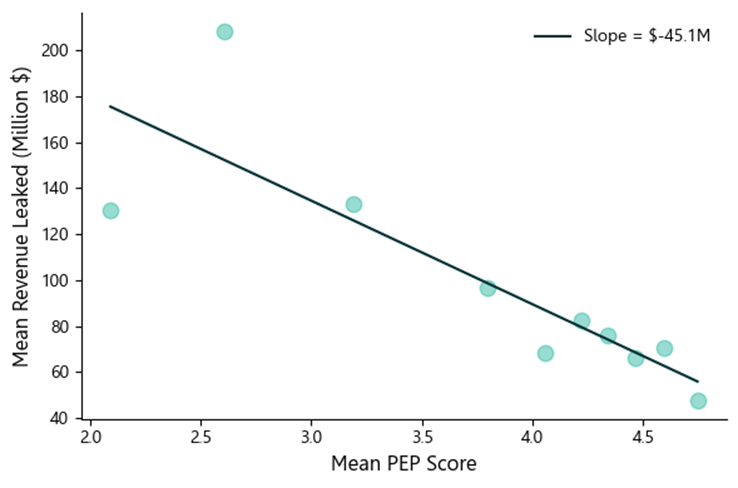
A strong correlation between PEP Scores and revenue leakage held across hospital sizes, geographies, and service mixes. With this broader dataset, we are now exploring leakage behavior by region, offering a path toward tailored benchmarks and interventions.
Connecting Experience, Trust, and Behavior
These findings reinforce what many clinicians already understand. As Hospitalogy recently wrote, “without trust, patients don’t show up, open up, or follow up.” That is the real-world impact of poor experience. The cost is both clinical and financial.
To make trust measurable, PEP Health introduced the Trust Score earlier this year. Built on the same patient feedback as the PEP Score, the Trust Score identifies how patients perceive empathy, competence, and authenticity. These are the building blocks of a lasting care relationship.
Together, the PEP Score and Trust Score reveal the emotional and operational factors that drive patient behavior. Whether a patient completes a treatment plan, recommends your system, or returns for care often comes down to these experiences.
Leakage is not just about competitive networks or market share. It is often the downstream effect of missed connections. Now, health systems have a way to track these early signs and act before patients leave.
A Strategic Opportunity
Experience is no longer just a quality measure. It is a financial and reputational lever. As health systems face increasing consumer expectations and pressure on margins, the ability to listen and respond to the patient voice is becoming essential.
With the PEP Score and Trust Score, health systems can:
- Identify high-friction experiences by location or service line
- Benchmark against local, regional, and national peers
- Anticipate leakage before it impacts revenue
- Prioritize improvements that reflect what patients actually value
This shift from retrospective reporting to proactive decision-making helps systems align performance with patient expectations. And the business case is stronger than ever.
Learn More
To explore how your system performs and how much could be retained by improving experience and trust, download our latest white paper:
The Missing Metric: Bringing Patient Trust Into Focus
Or visit pephealth.ai to request a custom PEP Score and Trust Score assessment for your organization.
