
Discharge planning is widely viewed as a process that should begin when a patient is admitted. In practice, however, many health systems still lack a standardized approach for coordinating that work across the care team. As a result, key decisions and updates may be shared informally, leaving clinicians and staff without a consistent view of what needs to happen before a patient can safely leave the hospital.
Scottsdale, Ariz.-based HonorHealth deployed the Qventus Inpatient Capacity Solution across six hospitals in 2021 and added two more in 2025. Before then, its multidisciplinary rounds varied by unit, had no physician participation and were not discharge-focused.
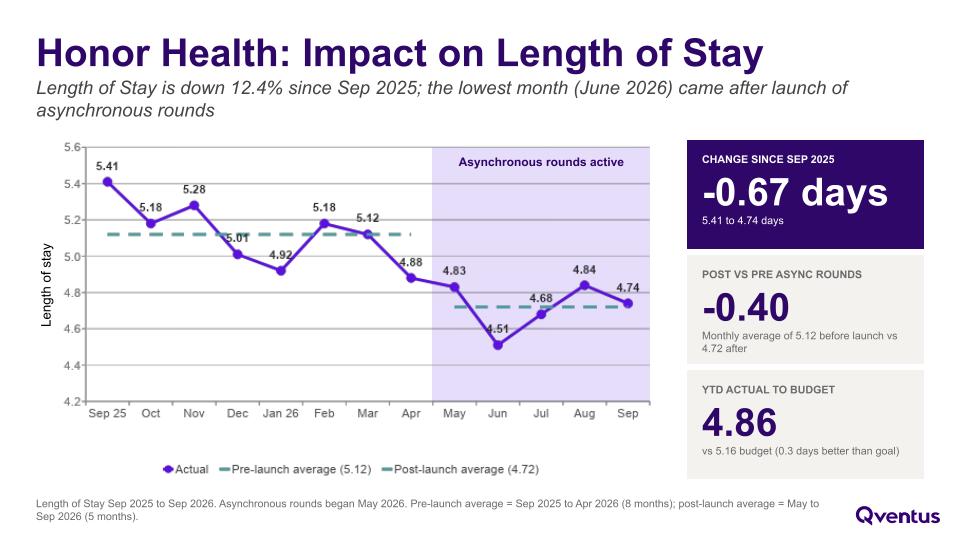
During a Becker’s Healthcare webinar sponsored by Qventus, Harold Peters, executive consultant for transformation and operations at HonorHealth, Lizandra Rubio, RN, interim network director of oncology outpatient operations at HonorHealth, Anthony Martinez, RN, clinical director at HonorHealth and Jason Cohen, MD, chief medical officer for inpatient at Qventus, discussed how the system reinvented discharge rounds three times and cut length of stay from 5.41 to 4.74 days year over year.
Below are four takeaways from their discussion.
1. A new approach to rounds
HonorHealth’s first rounds were in person and hour-long, with each hospitalist covering their patients in a 10-minute segment while everyone else waited. Moving the format to Microsoft Teams let participants multitask, but it compressed the discussion.
“When you’re only having about 20 to 30 seconds per patient, what we found was that the fidelity of our rounds started to fall off and our improvements started to plateau,” Mr. Peters said.
The team had rejected asynchronous rounds in 2021 because losing the physician’s live voice felt too costly. When its largest hospital pushed for a new approach, staff surveys showed the efficiency gain more than offset that loss. “We certainly have found that this model now has very few drawbacks. Actually, from a data perspective, there are none,” Mr. Peters said.
2. The clinicians’ voice matters
HonorHealth kept its rounds in place and asked hospitalists to complete their portion beforehand. Providers enter an expected discharge date, disposition, morning or afternoon timing and any barriers into an Epic side panel HonorHealth calls the QCard, which also houses the Qventus discharge planning assistant.
Trained on each hospital’s own data, the assistant predicts a discharge date and disposition by the first morning after admission and updates them as the patient’s condition changes. Qventus reports its inpatient assistants cut excess days 15% to 30% and automate 85% to 90% of discharge milestones.
Nurses, therapy and case management then round on the unit against the QCard, routing questions back to the provider afterward. “The providers putting in the information before helped their voice still stand at the meeting whenever they’re on the unit,” Ms. Rubio said.
Rounds now take 30 to 35 minutes instead of an hour, and Mr. Martinez said staff feedback was overwhelmingly positive. At John C. Lincoln Medical Center, live with asynchronous rounds since May, rolling 12-month average length of stay fell from 5.41 days in September 2025 to 4.74 – that’s a 12% shorter LOS.
Smaller hospitals that can cover every patient in under an hour stayed synchronous.
3. Reports alone will not change outcomes
Ms. Rubio said HonorHealth’s early challenge was turning data into action. Throughput goals such as discharge before noon existed, but bedside staff did not know them. Making goals explicit created shared accountability, and throughput committees spread what was working across hospitals.
“The technology is creating visibility, but we need to have clear goals and ownership and consistent follow-through,” she said.
4. The importance of partnership
Mr. Peters’ sharpest advice was about how to frame the work internally.
“You can never think of this just as an EMR module that’s going to be implemented by your EMR team or your IT team,” he said. The learning ran both ways, and Dr. Cohen said HonorHealth pushed Qventus toward asynchronous rounds. Next, the system wants AI to flag discharge orders that are not actionable against its 21% discharge-before-noon target.
Mr. Peters said HonorHealth now sits in the top decile for length of stay and top quartile for excess days among Epic customers.
“There’s no AI solution out there today where you just open the box in clinical care and let it loose and it solves a problem,” Dr. Cohen shared. “This is an ongoing commitment on the part of Qventus, on the part of the health system, to automate care operations and improve the experience of providers and patients.”
