
Healthcare organizations have been operating in survival mode. Protecting thin margins, managing workforce strain, and absorbing continuous disruption. These near-term pressures have been unavoidable and consuming.
Yet even as daily demands capture leadership attention, critical questions are emerging: Are existing care models, footprints, and capabilities suited for what lies ahead? What will the workforce model need to look like? And how should organizations select collaborators and partners for a future that is destined to be dramatically different?
The forces reshaping healthcare are already at work, challenging leaders to look beyond immediate constraints and confront how their organizations must evolve to remain viable and effective over the next decade.
The four forces
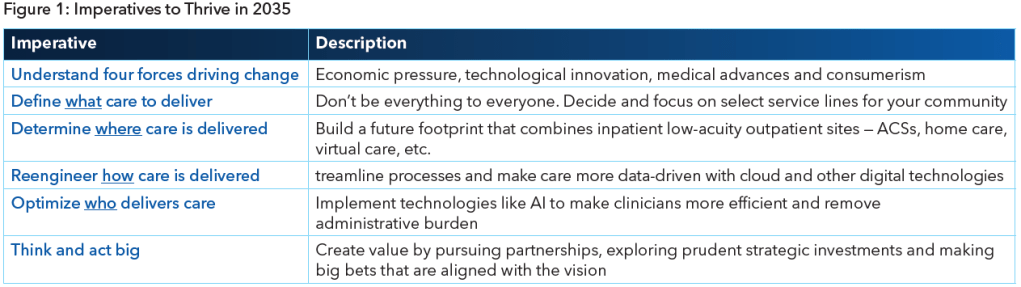
PwC identifies four forces pressing transformation of the US health industry: persistent and growing economic pressure, technological innovation, transformative medical advances, and consequential, shifting consumer behavior.
According to Alena Taylor, lead provider strategy partner at PwC, navigating economic pressures and technological innovation are the most significant priorities for providers. According to PwC’s analysis, the median operating margin of the nation’s 20 largest health systems was just 1.5% in 2024, placing many systems in survival mode.
“Economic uncertainty is real for providers — especially for academic medical centers and rural health systems,” Ms. Taylor said. “To get ahead of these pressures and ensure a sustainable health system for decades to come, organizations must consider structural shifts in portfolio focus, cost structure and operating model design.”
One strategy for dealing with economic pressures is thoughtful adoption of technology, including AI. But, in contemplating future technology investments, providers need to strike a balance between continued investment in their core infrastructure and investments in new tools and systems.
Rather than simply jumping on the AI bandwagon, leaders should develop a strategic approach for investing in technology that generates measurable improvements in clinical quality, labor productivity, and financial performance.
The four questions
The future of healthcare will be defi ned by integrated, data-driven environments that enable providers to deliver consistently high quality, coordinated care to patients.
To deliver on this vision, provider leaders should fundamentally rethink and answer four questions:
– What care is being delivered?
– Where is it delivered?
– How is it delivered?
– Who delivers it?
What care is being delivered?
Health systems should assess the clinical services their community needs and strategically decide which service lines to offer in a particular market or at a specific facility.
According to Ms. Taylor, organizations attempting to be all things to all people often fail because they dilute their value, ultimately resonating with no one. As technology has provided consumers with more options this same principle increasingly applies to hospitals.
“It’s ineffective for most organizations to be offering ‘everything to everyone’ in each of their hospitals,” Ms. Taylor said. “Each campus should have a clearly defi ned clinical identity aligned to community demand and sustainable volume thresholds required to maintain high quality standards. In many cases, that may mean finding alternate ways to provide fragmented, sub-scale services in the community, a step many organizations have been hesitant to take in the past.”
Thriving in the future doesn’t mean just stopping some services; it also means redeploying capital and clinical talent into differentiated, strategically advantaged service lines.
Where is care being delivered?
In concert with deciding what service lines to provide, leaders should also determine the right care setting for each service.
To avoid being constrained by a health system’s existing physical footprint and infrastructure, Ms. Taylor recommends engaging in “ground zero” thinking, in which teams envision the optimal sites of care, unconstrained by legacy infrastructure. Key factors to consider include demand, acuity, access, convenience, and cost.
She explained that as more low-acuity services shift to ambulatory surgery centers (ASCs), micro-hospitals, virtual care and hospital-at-home programs, health systems will need significantly less traditional inpatient capacity in certain markets. If avoidable admissions continue to decline and lower-acuity volume keeps moving outward, some systems could require substantially less inpatient footprint, potentially as much as half of what exists today.
As a result, remaining hospital facilities would increasingly concentrate on high-acuity care, including critical care and complex surgical services.
How is care being delivered?
Historically, health systems have underutilized formal process engineering disciplines. Health systems should embrace care engineering to streamline processes, reduce variability, prevent excess utilization, and improve outcomes.
Reengineering care delivery starts with using data to empower clinical teams to make faster, more informed decisions. This requires a robust, modern digital foundation.
A full cloud-based data platform allows teams to unify financial and operational data at every level. With a single source of truth, health systems can deploy centralized operational command capabilities and AI-supported decision tools that accelerate throughput, improve capacity management and strengthen revenue cycle performance.
Working together, technology and process evolution help ensure that patients receive the right care in the right place at the right time. Ms. Taylor underscored the need for coordination among operations, clinical care teams and technologists as organizations stand up technology solutions. This ensures that digital solutions fit the requirements of the business and make the lives of users easier, rather than harder
“One of the most common pitfalls is viewing technology projects as one more initiative to implement and check off the digital roadmap. But it costs a lot more on the back end when projects don’t meet business needs resulting in considerable rework,” Ms. Taylor said.
When strong coordination exists among all stakeholder groups during implementations, optimization efforts and ongoing improvement projects, digital modernization efforts generate better, faster ROI.
Who delivers the care?
In the future, care will still be provided by people, but they will be empowered and supported by technologies that make them more effective and efficient.
By reimagining workflows and eliminating routine work with AI and automation, it’s possible to transform the employee experience, address workforce shortages and turn burnout into engagement.
Healthcare has been slow to adopt new technologies, but in recent years, the sector has flipped the script. According to a Menlo Ventures report, healthcare organizations are adopting AI at more than double the rate of other industries.
Health leaders involved in provider strategy have shifted their thinking on AI over the past 18 months. Once content to be fast followers, many now are actively embracing the technology, adopting everything from ambient listening tools to AI-enabled revenue cycle optimization.
“It shows that the ROI of AI in healthcare is increasing at a rapid pace leading to broad adoption,” Ms. Taylor said. “We are now also seeing increased AI adoption to support clinical decision-making.”
By integrating AI into daily routines, clinicians can operate at the top of their licenses, achieving a more sustainable work-life balance, expanding time at the bedside, and reaching more patients. AI can also help providers strengthen relationships with patients and their caregivers while maintaining transparency and trust.
Organizations must be clear about how AI will augment roles for employees to minimize resistance among care teams. Best practices include getting people involved early, providing adequate training and explaining how AI will enable clinicians to work more effectively and spend more time with patients.
A future of new collaborators
Long‑term success will depend not only on how care is delivered, but on how organizations create value through partnerships and strategic investments.
Partnerships with pharmaceutical and medtech companies, new market entrants, tech companies, and even competitors, allow providers to focus on and invest in core strengths, while gaining access to new capabilities.
“Providers will partner in novel ways to provide care across their communities,” Ms. Taylor said.
Partnership arrangements can expand access to care, increase capacity, enhance specialty capabilities, and strengthen financial sustainability. Through partnerships, providers can offer more holistic, preventive and home-based care for patients and the community.
Providers can also benefit by exploring partnerships in non-clinical functions outside of their core capabilities. Such collaborations can help build economies of scale and enable access to more advanced technology than providers could achieve on their own.
In addition to partnerships, strategic investments can also create significant value. However, not every opportunity warrants pursuit. As deal markets heat up, organizations risk falling prey to the “thrill of the buy.” Hospitals and health systems must remain anchored to their vision and to what they ultimately want to be known for.
“The most successful providers bring a discerning eye to potential investments and ask whether an opportunity aligns with their growth strategy or fills core capability gaps,” Ms. Taylor said. “This discipline leads to better outcomes as organizations integrate new assets into their portfolios.”
At the same time, leaders cannot afford to be timid. The days of incremental, marginal change are over. Once organizations determine which service lines, sites of care and capabilities they want to build, they must be prepared to make bold moves. By being bold, they create value by enabling differentiation, improving agility and sustaining long-term revenue growth.
The right move will differ based on an organization’s type, market dynamics and existing portfolio.
“Are you an academic medical center focused on optimizing for the full tripartite mission, a standalone hospital defining its role in the community, a multi-state health system optimizing for strong enterprise functions or an integrated delivery network laser focused on tackling reduced cost of care? Those differences will drive decision-making and what’s right for an organization,” Ms. Taylor said.
The forces reshaping healthcare are already in motion. Providers cannot afford to wait. Those that move decisively now will be best positioned for 2035 and beyond.
Becker’s 3rd Annual Fall Chief Pharmacy Officer Summit is the top tier event that the people leading the future of pharmacy convene. This 3-day event is built specifically for Chief Pharmacy Officers and senior pharmacy leaders. The sessions examine the workforce, financial and clinical priorities shaping pharmacy today. Becker’s is where candid discussions flourish and new ideas thrive. Becker's 3rd Annual Fall Chief Pharmacy Officer Summit
