
April 2026 Issue of Becker’s Hospital Review
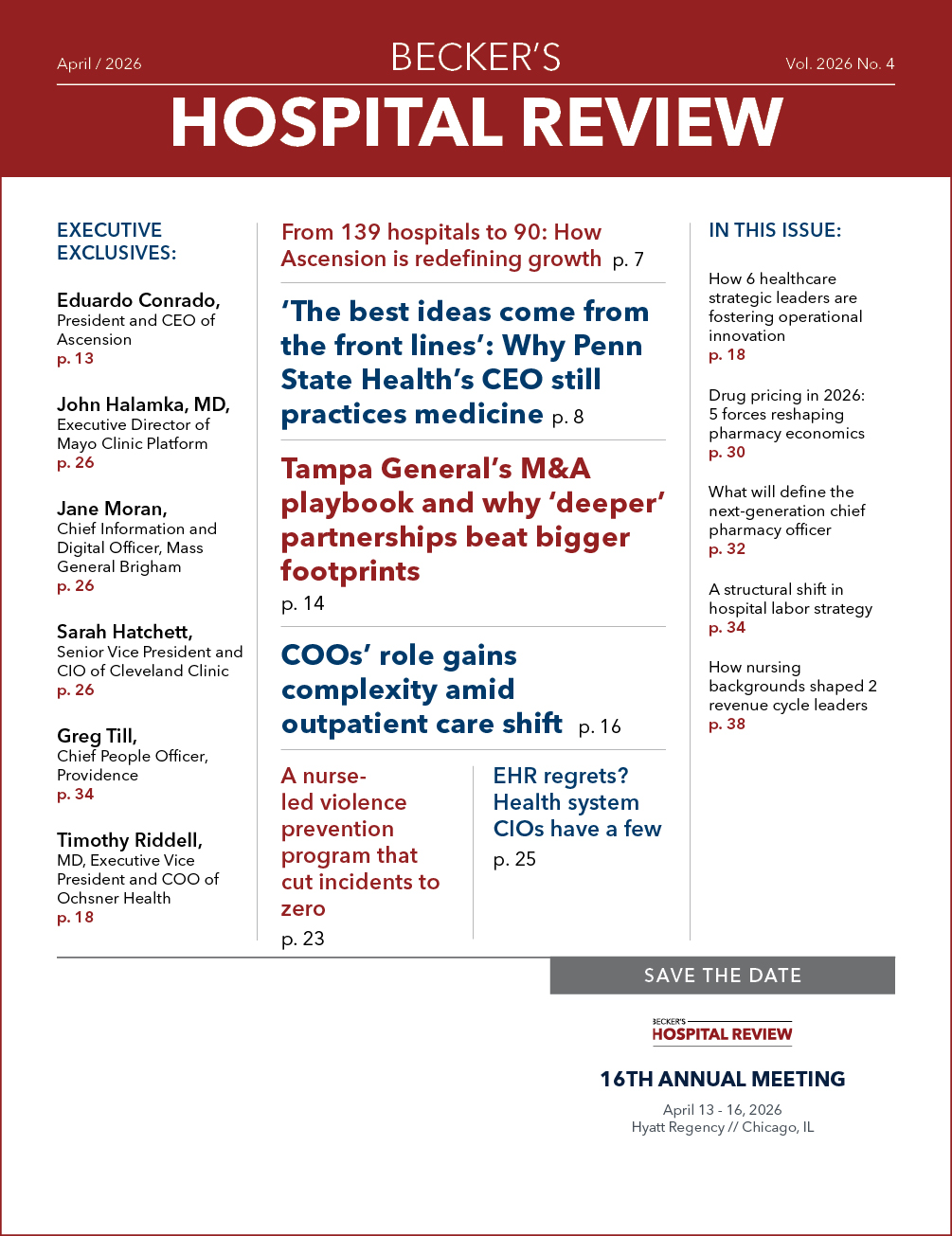
On The Cover
Eduardo Conrado, President and CEO of Ascension
St. Louis-based Ascension is redesigning its care delivery model as looming Medicaid cuts and the expiration of enhanced ACA premium tax credits are expected to increase the number of uninsured patients, strain emergency departments and intensify financial pressure on hospitals, President and CEO Eduardo Conrado wrote in a Feb. 16 LinkedIn post.
John Halamka, MD, Executive Director of Mayo Clinic Platform
After attending HIMSS March 9-12 in Las Vegas, health system CIOs are excited about implementing agentic AI — and getting a return on investment from it — while governance is becoming “cool,” as one leader put it.
Jane Moran, Chief Information and Digital Officer, Mass General Brigham
After attending HIMSS March 9-12 in Las Vegas, health system CIOs are excited about implementing agentic AI — and getting a return on investment from it — while governance is becoming “cool,” as one leader put it.
Sarah Hatchett, Senior Vice President and CIO of Cleveland Clinic
After attending HIMSS March 9-12 in Las Vegas, health system CIOs are excited about implementing agentic AI — and getting a return on investment from it — while governance is becoming “cool,” as one leader put it.
Greg Till, Chief People Officer, Providence
The hospital staffing emergency has cooled from its pandemic peak, but labor pressure has not disappeared — it has shifted. Rather than trying to out-hire shortages or outbid competitors for scarce talent, more systems are treating workforce strain as a strategic pivot point: redesigning work, cutting contract labor and using technology to expand capacity.
Timothy Riddell, MD, Executive Vice President and COO of Ochsner Health
Across healthcare organizations of every size and setting, strategic leaders are redefining what operational excellence and innovation look like in practice. From rural turnaround efforts to academic cancer centers and large health systems, executives say sustainable progress depends on disciplined performance management, frontline engagement and cultures that reward experimentation. Leaders are creating psychological safety, investing in continuous improvement training and aligning every initiative to measurable outcomes.
From 139 hospitals to 90: How Ascension is redefining growth
In 2022, St. Louis-based Ascension began an operational transformation aimed at strengthening long-term sustainability following the financial strain of the COVID-19 pandemic. The effort included strategic divestitures, market exits and the rollout of a more disciplined operating model, Amber Sims, executive vice president and chief strategy and growth officer, told Becker’s.
‘The best ideas come from the front lines’: Why Penn State Health’s CEO still practices medicine
When Michael Kupferman, MD, became CEO of Hershey, Pa.-based Penn State Health in late June 2025, he brought a special background that not all health system executives have: decades of work as a physician.
Tampa General’s M&A playbook and why ‘deeper’ partnerships beat bigger footprints
As financial pressures continue to strain rural and community hospitals, academic health systems are increasingly stepping in as operators, affiliates or strategic partners.
COOs’ role gains complexity amid outpatient care shift
As technology advances and care shifts toward outpatient, virtual and community-based settings, the role of the COO is also evolving. For leaders in this position, that means new skill sets and a broader range of focuses, from managing hospital operations to coordinating complex, widely distributed networks of care.
A nurse-led violence prevention program that cut incidents to zero
WakeMed Raleigh (N.C.) has gone 20 consecutive months without a single workplace violence incident on its medical-surgical unit. It is all thanks to a program created by three nurse leaders.
EHR regrets? Health system CIOs have a few
If healthcare IT were golf, CIOs would take a few mulligans.
How 6 healthcare strategic leaders are fostering operational innovation
Across healthcare organizations of every size and setting, strategic leaders are redefining what operational excellence and innovation look like in practice. From rural turnaround efforts to academic cancer centers and large health systems, executives say sustainable progress depends on disciplined performance management, frontline engagement and cultures that reward experimentation. Leaders are creating psychological safety, investing in continuous improvement training and aligning every initiative to measurable outcomes.
Drug pricing in 2026: 5 forces reshaping pharmacy economics
Drug pricing in 2026 is being reshaped at the pharmacy counter, in federal agencies and in courtrooms — all at once.
What will define the next-generation chief pharmacy officer
Over the next three to five years, the chief pharmacy officer role is expected to expand well beyond operational oversight. Dispensing excellence and medication safety will remain foundational. But what will distinguish successful leaders in 2026 and beyond is enterprise-level influence — across finance, technology, workforce, supply chain and policy — paired with the ability to build teams that can execute in a volatile healthcare environment.
A structural shift in hospital labor strategy
The hospital staffing emergency has cooled from its pandemic peak, but labor pressure has not disappeared — it has shifted. Rather than trying to out-hire shortages or outbid competitors for scarce talent, more systems are treating workforce strain as a strategic pivot point: redesigning work, cutting contract labor and using technology to expand capacity.
How nursing backgrounds shaped 2 revenue cycle leaders
Mount Sinai Chief Revenue Officer Debra Jaeger, MSN, RN, has found space for herself as a liaison between clinical and financial teams.
CFO Finance
From 139 hospitals to 90: How Ascension is redefining growth
In 2022, St. Louis-based Ascension began an operational transformation aimed at strengthening long-term sustainability following the financial strain of the COVID-19 pandemic. The effort included strategic divestitures, market exits and the rollout of a more disciplined operating model, Amber Sims, executive vice president and chief strategy and growth officer, told Becker’s.
‘The best ideas come from the front lines’: Why Penn State Health’s CEO still practices medicine
When Michael Kupferman, MD, became CEO of Hershey, Pa.-based Penn State Health in late June 2025, he brought a special background that not all health system executives have: decades of work as a physician.
CEO Strategy
‘That approach is no longer good enough’: Ascension CEO rethinks care delivery model as uninsured volumes rise
St. Louis-based Ascension is redesigning its care delivery model as looming Medicaid cuts and the expiration of enhanced ACA premium tax credits are expected to increase the number of uninsured patients, strain emergency departments and intensify financial pressure on hospitals, President and CEO Eduardo Conrado wrote in a Feb. 16 LinkedIn post.
Tampa General’s M&A playbook and why ‘deeper’ partnerships beat bigger footprints
As financial pressures continue to strain rural and community hospitals, academic health systems are increasingly stepping in as operators, affiliates or strategic partners.
COO
COOs’ role gains complexity amid outpatient care shift
As technology advances and care shifts toward outpatient, virtual and community-based settings, the role of the COO is also evolving. For leaders in this position, that means new skill sets and a broader range of focuses, from managing hospital operations to coordinating complex, widely distributed networks of care.
How 6 healthcare strategic leaders are fostering operational innovation
Across healthcare organizations of every size and setting, strategic leaders are redefining what operational excellence and innovation look like in practice. From rural turnaround efforts to academic cancer centers and large health systems, executives say sustainable progress depends on disciplined performance management, frontline engagement and cultures that reward experimentation. Leaders are creating psychological safety, investing in continuous improvement training and aligning every initiative to measurable outcomes.
Clinical Leadership
A nurse-led violence prevention program that cut incidents to zero
WakeMed Raleigh (N.C.) has gone 20 consecutive months without a single workplace violence incident on its medical-surgical unit. It is all thanks to a program created by three nurse leaders.
MSU Health Care’s CMO on the biggest barrier to sustained quality improvement
Burnout and disengagement among clinicians remain one of the biggest barriers to sustained improvements in quality and patient safety, according to Mark Smith, MD, chief medical officer of East Lansing, Mich.-based MSU Health Care.
CIO
EHR regrets? Health system CIOs have a few
If healthcare IT were golf, CIOs would take a few mulligans.
The buzz at HIMSS 2026: 6 notes
After attending HIMSS March 9-12 in Las Vegas, health system CIOs are excited about implementing agentic AI — and getting a return on investment from it — while governance is becoming “cool,” as one leader put it.
What health systems learned from the Stryker cyberattack
The recent cyberattack on medtech company Stryker must serve as a “wake-up call” about hackers’ evolving tactics, even as it illustrates a “new normal” in healthcare, health system leaders told Becker’s.
PHARMACY
Drug pricing in 2026: 5 forces reshaping pharmacy economics
Drug pricing in 2026 is being reshaped at the pharmacy counter, in federal agencies and in courtrooms — all at once.
Why pharmacy integration is no longer optional
As therapies become more specialized and expensive, patients are relying on pharmacy teams for more than medication dispensing. Health systems are responding by integrating pharmacists more deeply into clinical care, particularly in specialty and oncology settings, where treatment complexity and coordination demands are highest.
What will define the next-generation chief pharmacy officer
Over the next three to five years, the chief pharmacy officer role is expected to expand well beyond operational oversight. Dispensing excellence and medication safety will remain foundational. But what will distinguish successful leaders in 2026 and beyond is enterprise-level influence — across finance, technology, workforce, supply chain and policy — paired with the ability to build teams that can execute in a volatile healthcare environment.
CHRO
A structural shift in hospital labor strategy
The hospital staffing emergency has cooled from its pandemic peak, but labor pressure has not disappeared — it has shifted. Rather than trying to out-hire shortages or outbid competitors for scarce talent, more systems are treating workforce strain as a strategic pivot point: redesigning work, cutting contract labor and using technology to expand capacity.
RCM Leader
‘We would be going out of business if we didn’t’: 4 leaders on converting to rural emergency hospitals
Pocahontas, Ark.-based St. Bernards Five Rivers Medical Center was already operating like a rural emergency hospital before it converted to the designation.
2 revenue cycle leaders on strategies that reduced denials
Ask a Revenue Cycle Leader is a new series featuring insights from health system and hospital revenue cycle executives nationwide. Becker’s poses questions on the most pressing issues in healthcare finance — from payer relations and automation to workforce and patient experience.
How nursing backgrounds shaped 2 revenue cycle leaders
Mount Sinai Chief Revenue Officer Debra Jaeger, MSN, RN, has found space for herself as a liaison between clinical and financial teams.
