
The share of federal hospital inspections that end in a serious nursing citation has nearly doubled since 2019, and California accounts for much of the jump.
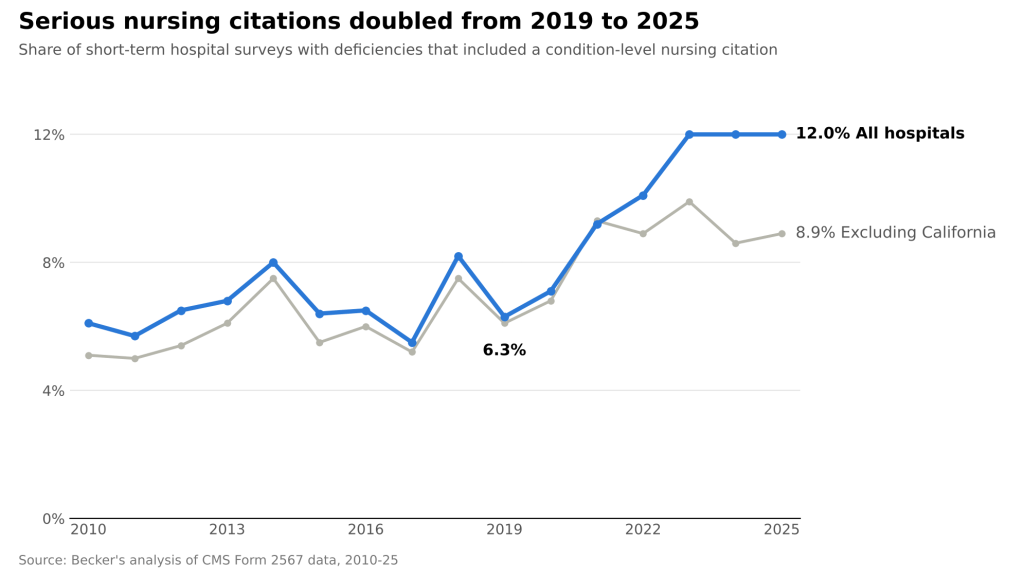
In 2025, 12% of short-term acute care hospital surveys that produced deficiencies included a condition-level citation for nursing services, up from 6.3% in 2019, according to a Becker’s analysis of CMS statements of deficiencies.
Condition-level citations are CMS’ most serious finding, short of immediate jeopardy. They mean surveyors determined a hospital was out of compliance with a Medicare Condition of Participation, which can put its Medicare participation at risk if it is not corrected.
California went from seven such citations in 2019 to 76 in 2025. Outside California, the rate still rose, but more modestly.
The national numbers
Condition-level nursing citations at short-term hospitals more than doubled in raw terms, from 82 surveys in 2019 to 183 in 2025.
The California factor
California accounted for 42% of the nation’s condition-level nursing citations at short-term hospitals in 2025, up from 9% in 2019.
The main driver is inspection volume: California hospitals now account for about 1 in 5 short-term hospital surveys that produced deficiencies nationwide, up from about 1 in 17 in 2019.
California surveys also tend to be more extensive. They averaged about five citations per survey in 2025, compared with about 2.7 in the rest of the country.
In 88% of California surveys with a condition-level nursing citation from 2023 to 2025, surveyors also cited the hospital under a standard called “supervision of contract staff.” Despite the name, that standard requires all licensed nurses to follow hospital policies, and the cited findings rarely involve agency or travel nurses.
Excluding California, the rate of condition-level nursing citations rose from 6.1% of surveys in 2019 to 8.9% in 2025, an increase of about 45%.
What surveyors found
The citations point more toward lapses in nursing practice than to shortages of nurses. From 2023 to 2025, a staffing-specific citation (“staffing and delivery of care”) appeared in only 20% of surveys with a condition-level nursing citation outside California, and 13% in California. Staffing-specific citations have stayed roughly flat nationally, at about 40 to 80 per year since 2010, even through the pandemic-era staffing crunch.
The more common companion citation was “RN supervision of nursing care,” which surveyors use when a registered nurse fails to assess, monitor or evaluate a patient as required. It appeared in about half of these surveys both inside and outside California.
A March 2026 complaint survey of a Lancaster, Calif.-based hospital shows what these findings can look like. Surveyors found registered nurses failed to supervise and evaluate care for four patients in uncontrolled pain. One patient’s pain was assessed “repeatedly as 10/10” without timely interventions, a reassessment within 30 minutes of medication or notification of a provider, according to the report.
In the emergency department’s “red zone,” an area where ambulance crews offload patients when no ED beds are available, surveyors documented missed vital signs checks, missed pain assessments and a lack of monitoring. One patient was found unresponsive “without nursing oversight or monitoring.” Surveyors wrote that the practice created “the risk of serious harm or death” for those patients and for “all facility patients requiring urgent and emergent care who continued to be offloaded by ambulance into the red zone areas.”
The report also shows how the contract staff standard is applied. The hospital’s citations under it involved a restrained patient who was not assessed every two hours, a patient who was not repositioned to prevent pressure injuries and an incomplete medication reconciliation.
Methodology
Becker’s analyzed CMS statements of deficiencies (Form 2567) for short-term acute care hospitals, covering surveys from January 2010 through Sept. 9, 2026.
Rates reflect the share of surveys with at least one hospital deficiency that included a condition-level nursing services citation (tag A0385). The data include only surveys that produced deficiencies, so rates are not a share of all inspections.
Becker’s 3rd Annual Fall Chief Pharmacy Officer Summit is the top tier event that the people leading the future of pharmacy convene. This 3-day event is built specifically for Chief Pharmacy Officers and senior pharmacy leaders. The sessions examine the workforce, financial and clinical priorities shaping pharmacy today. Becker’s is where candid discussions flourish and new ideas thrive. Becker's 3rd Annual Fall Chief Pharmacy Officer Summit
