
A simpler, more cost-effective way to improve accountability, identify potential diversion, and gain real-time oversight—without replacing your existing narcotic cabinets.
For many ambulatory surgery centers, controlled substance documentation still relies on a process that has changed very little in decades: handwritten narcotic logs, manual counts, paper signatures, and time-consuming reconciliation.
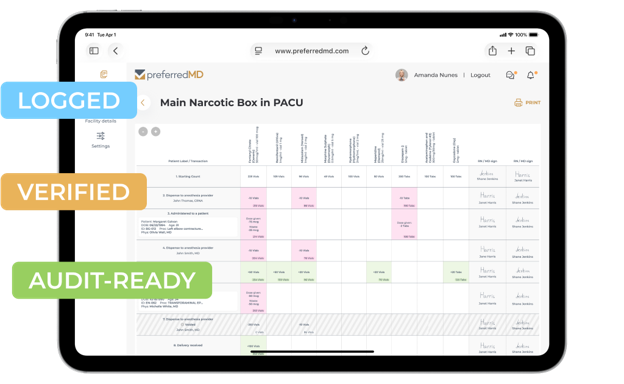
While the process may be familiar, the limitations are significant. Paper logs can be difficult to read, difficult to audit, and even more difficult to analyze for patterns that may indicate drug diversion. For ASC administrators and Directors of Nursing, gaining meaningful oversight can require manually reviewing pages of documentation after the fact.
PreferredMD offers a better way.
PreferredMD’s Digital Controlled Substance Log was designed specifically for ambulatory surgery centers that want the benefits of electronic accountability without replacing their existing medication storage infrastructure or forcing nurses and anesthesia providers to learn an entirely new workflow.
Modernize the Log—Not the Entire Medication Room
One of the biggest barriers to implementing controlled substance technology is cost and complexity.
Traditional automated dispensing systems can require a significant capital investment in new narcotic cabinets, equipment installation, ongoing maintenance, and changes to existing clinical workflows.
PreferredMD takes a different approach.
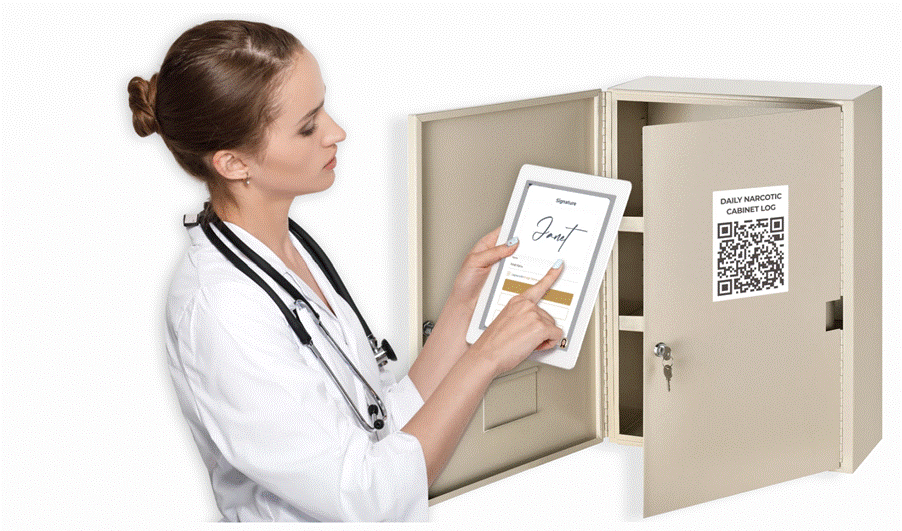
Facilities can continue using their existing narcotic cabinets and medication storage processes. Nurses and anesthesia providers continue following a workflow that is familiar to them—accessing medications, documenting transactions, recording counts, and reconciling controlled substances.
The difference is that the documentation is now digital.
Instead of asking staff to completely change how they work, PreferredMD replaces the paper log with a secure, structured electronic process. This makes implementation considerably easier and helps reduce the disruption that often accompanies new clinical technology.
For many ASCs, the transition can be viewed simply: keep the cabinet, keep the workflow, eliminate the paper.
Make Drug Diversion Easier to Identify
Paper logs are designed primarily to document transactions. They are not designed to analyze them.
That distinction matters when trying to identify potential drug diversion.
A paper narcotic log may contain hundreds or thousands of individual transactions. Identifying recurring discrepancies, unusual waste patterns, unexpected medication usage, or activity associated with a specific provider can require hours of manual review.
PreferredMD turns those transactions into structured data that can be searched, reviewed, and reported.
ASC leadership can more easily identify patterns that warrant further investigation, including recurring count discrepancies, incomplete documentation, unusual waste activity, or unexpected medication-use trends.
Rather than relying solely on someone noticing a problem while reviewing handwritten entries, reporting gives administrators another layer of visibility into controlled substance activity.
Technology cannot replace a comprehensive drug-diversion prevention program, but it can make potentially concerning patterns significantly easier to see.
Remote Oversight Without Being in the Medication Room
Another major advantage of digital controlled substance documentation is visibility.
With paper logs, oversight often requires an administrator or Director of Nursing to physically review a binder or wait for documents to be scanned and sent.
PreferredMD allows authorized leadership to review controlled substance activity remotely.
Administrators can monitor open logs, review transactions, follow reconciliation activity, and identify documentation issues without needing to be physically present at the facility.
This can be particularly valuable for management companies and organizations operating multiple ASCs. Instead of maintaining separate paper processes at each location, leadership can gain centralized visibility across facilities.
Remote oversight can also help identify outstanding issues sooner rather than waiting until the end of the month, an internal audit, or an accreditation survey.
A Cost-Effective Alternative to Expensive Hardware
Improving controlled substance accountability should not necessarily require a major capital expenditure.
Automated dispensing cabinets can provide significant functionality, but they can also involve substantial equipment, implementation, maintenance, and service costs.
For many ASCs, particularly independent centers and smaller organizations, replacing existing narcotic cabinets may not be necessary simply to improve documentation and oversight.
PreferredMD provides a software-based approach that allows facilities to modernize their controlled substance process while continuing to use the infrastructure they already have.
That can dramatically reduce both the financial and operational barriers to moving away from paper.
Instead of purchasing new cabinets throughout a facility, ASCs can focus their investment on improving accountability, reporting, audit readiness, and management visibility.
The Better Alternative to Paper
Moving away from paper narcotic logs does not have to mean completely redesigning your medication-management process.
The most effective technology often improves the workflow clinicians already understand rather than forcing them to abandon it.
PreferredMD was built around that principle.
ASCs can maintain familiar workflows for nurses and anesthesia providers, continue using their existing narcotic cabinets, and gain the benefits of digital documentation, reporting, remote oversight, and more efficient reconciliation.
The result is a practical path away from an outdated paper process—without unnecessary complexity or capital expense.
For ASC leaders looking to strengthen controlled substance accountability while making life easier for their clinical teams, the question may no longer be whether to move beyond paper narcotic logs.
The question is why continue using them when there is a better way.
