
Rising anesthesia subsidies are often treated as a staffing or reimbursement problem. But for many hospitals, the larger issue sits between the two: how effectively staffed anesthesia capacity is converted into procedural volume, documented care and ultimately collected revenue.
That makes anesthesiology both an operational and financial issue.
Staffing models, utilization, scheduling, care team design, provider turnover, medical direction and location of care all influence the economics of anesthesia before a claim is ever submitted. On the other side, provider enrollment, documentation, coding, payer behavior, denials and reimbursement determine how much of that clinical activity becomes realized revenue.
For hospital executives, managing those functions separately can obscure where value is actually being lost.
Productive capacity is the starting point
Many organizations continue to carry significant anesthesia expense even when staffed operating room capacity is not fully utilized.
Surgical Directions recommends evaluating adjusted OR utilization against a practical target of approximately 75%, while many hospitals operate closer to 50% to 65%. In one 23-room OR example, fixed anesthesia overhead of approximately $2,300 per staffed OR per day contributed to an estimated $4 million in annual unused anesthesia capacity because staffed rooms were not consistently utilized.
“No revenue cycle management (RCM) strategy can recover revenue from a staffed operating room that never produces a case,” said Jason Klopotowski, MD, Lead Physician Managing Director at Surgical Directions. “Hospitals have to align anesthesia coverage, care team design and provider time with actual procedural demand. That is where the economics of anesthesiology begin.”
OR utilization alone, however, does not guarantee productive anesthesia utilization. Hospitals also need to examine how cases are sequenced, how late-day coverage is managed and how anesthesia resources are deployed across operating rooms and non-operating room anesthesia locations.
Care team design adds another layer. Medical direction, medical supervision, independent practice, provider-to-room ratios, break coverage and staffing drawdown decisions can all affect documentation and billing requirements.
Revenue performance starts before billing
Revenue leakage can begin long before a claim reaches the payer.
Provider enrollment is one example. When hospitals add clinicians, use locums, expand into new locations or transition anesthesia groups, enrollment delays can postpone reimbursement even while provider costs are already being incurred.
Documentation presents similar risk. Anesthesia reimbursement depends on accurate capture of time, base units, modifiers, medical direction and procedure information.
“RCM performance starts well before a claim is submitted,” said Jason Greenberg, MD, EVP & Chief Commercial Officer at Ventra Health. “Provider enrollment, documentation, coding and communication between clinical and revenue cycle teams all determine how effectively delivered care is converted into reimbursement.”
Ventra Health serves more than 900 anesthesiology facilities, processing approximately 18,000 claims per day and achieving 98% coding accuracy .
A 2026 Ventra case study involving Centra Health illustrates the potential impact of disciplined revenue cycle management. Centra’s anesthesia service line reported average days in accounts receivable of 35, an average denial rate below 5% and 20% of A/R over 90 days, excluding self-pay. Following the 2024 Change Healthcare disruption, Centra also reported a 4.3% improvement in net collections rate, a $46,000 increase in average monthly collections and an $18 increase in collections per visit. The results are specific to Centra and should not be viewed as universal benchmarks.
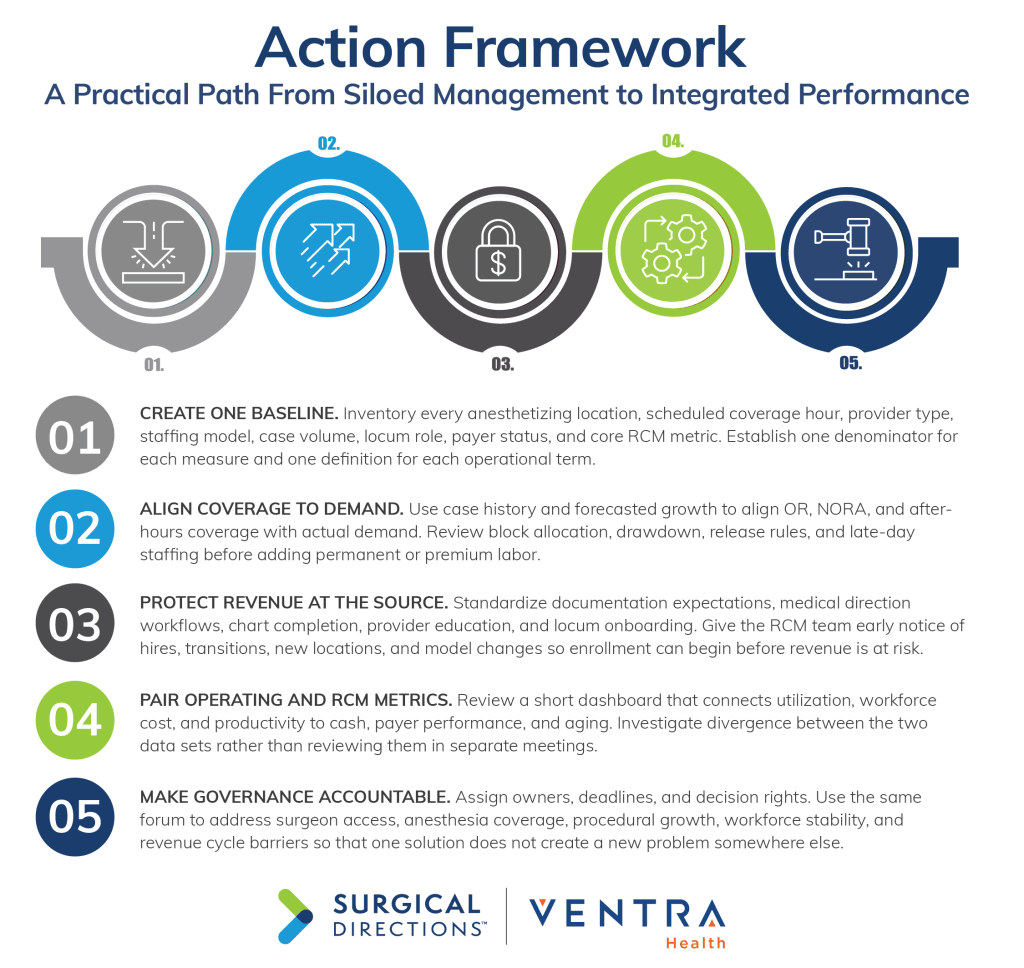
One dashboard, one financial story
The opportunity for hospital leaders is to connect both sides of the economics.
Adjusted utilization, provider productivity, locum expense and cost per case should be reviewed alongside net cash collections, cash per case, days in A/R, aged receivables and net collection performance.
The value comes from seeing where the measures diverge.
If utilization improves but cash per case declines, leaders need to understand why. If locum expense rises while A/R days worsen, enrollment or documentation may be contributing factors. If collections remain strong while the cost per anesthetizing location increases, coverage design may need to be reassessed.
Anesthesiology is no longer simply a question of controlling subsidy or improving collections. For hospital leaders, the more important question is whether operations and RCM are working together to convert anesthesia capacity into procedural access, clinical activity and sustainable financial performance.
About Ventra Health
Ventra Health is a leading business solutions provider for facility-based physicians in anesthesia, emergency medicine, hospital medicine, and radiology. We combine deep revenue cycle management expertise with white-glove service and transparent, AI-powered solutions – solving complex revenue and reimbursement challenges so clinicians can focus on patient care.
As one of the nation’s most advanced technology-enabled RCM providers, Ventra delivers industry-leading technology, data and analytics, provider enrollment and education, and payer strategy and contracting. Visit www.ventrahealth.com to learn more.
About Surgical Directions
Surgical Directions™ is a healthcare solutions company specializing in surgical services, procedural care, sterile processing, anesthesiology, and radiology services. With a unique clinician-led model and proprietary analytics platform, Merlin™, the firm empowers hospitals and provider groups to drive measurable improvements in access, efficiency, and financial performance. From supply chain optimization to governance redesign, Surgical Directions delivers peer-to-peer partnership and clinical expertise that helps clients provide quality care and improve margins. Learn more at www.surgicaldirections.com.
