
The Emergency Department Benchmarking Alliance is a voluntary membership organization which gathers performance measures from more than 2,000 participating emergency departments. The organization performs ad hoc surveys to provide ED and hospital managers with timely information on data trends.
EDBA members collectively noted volume changes in the first quarter of 2026, so a survey of members occurred regarding the volume of patients seen. This is timely because some hospital leaders view the first quarter as a trendsetter for volumes for the year, especially for budgeting purposes.
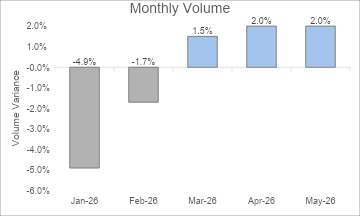
The EDBA survey found that ED volumes decreased in January and February 2026, compared to those months in 2025. In about 66% of EDs nationwide, the total volume for the first quarter decreased.
But these early results may not be an accurate predictor of ED volumes for the remainder of the year. When regional breakdowns were done, EDs in the western portion of the country actually had ED volume increases across the first quarter. EDs in the Midwest had the greatest tendency to decreased volumes, with some seeing volume decreases of 6% to 10%. ED leaders speculated that significant cold weather and winter storms drove the volume decreases, which made the geographic differences most plausible. Those weather events were most impactful in the Midwest and Northeast in January and February.
For those EDBA members that traced ED visits week by week, and into the early May time period, the ED volumes have recovered and are now on pace for increases for the rest of the year.
So the first two months of 2026 may not be a leading indicator of the volume for the rest of 2026. ED and hospital leaders would be wise to plan and staff for ongoing volume increases in U.S. EDs for the rest of the year.
The volume trend in American EDs has been upward since World War II, except for a two-year decrease in the first pandemic years. ED visit increases have been correlated to the aging population, and that demographic is not changing. Obviously, the most important element of ED visits is what is happening in the region where your ED is operating, and what volume changes are occurring in your walls.
Here are key findings from EDBA’s Volume Survey for Q1 2026:
• 66% of EDs report volume decline in Q1 versus Q1 of 2025. Only 28% reported increases.
• Larger volume EDs across the country reported less volume loss than smaller volume ED’s. The Midwest reported the biggest declines, with 78% of EDs reporting decreased volume.
• The West region reported volume increases in 64% of EDs.
• Those members that gave supplemental data regarding monthly volumes showed a tendency to have volume losses that were larger in January, and by March their volume had increased. Those EDs also reported volume increases into April. This is displayed in Figure below.
James Augustine, MD, FACEP, is vice president of the EDBA.
Maureen Canellas, MD, MBA, FACEP, is an EDBA board member and associate chief medical officer of UMass Memorial Medical Center in Worcester, Mass.
