
“What happens if we have a difficult claim year?”
It’s a question healthcare executives should be asking before they renew their professional liability insurance. Testing the program against a single large loss can show how it might respond to one severe claim, but not how it performs across a full policy year with multiple claims of varying severity. For healthcare organizations retaining meaningful risk, that distinction can have significant implications for the balance sheet.
When Claims Accumulate
The financial picture changes when losses accumulate across a policy year. Consider a health system with a $2 million self-insured retention (SIR) for each claim and a $10 million/$10 million excess policy above the SIR, meaning a $10 million per-claim limit and a $10 million annual aggregate.
Suppose four covered claims of $2.5 million each occur during the year. The organization retains $2 million on each, or $8 million in total. Insurance responds to the remaining $500,000 on each claim, using $2 million of the annual aggregate and leaving $8 million available.
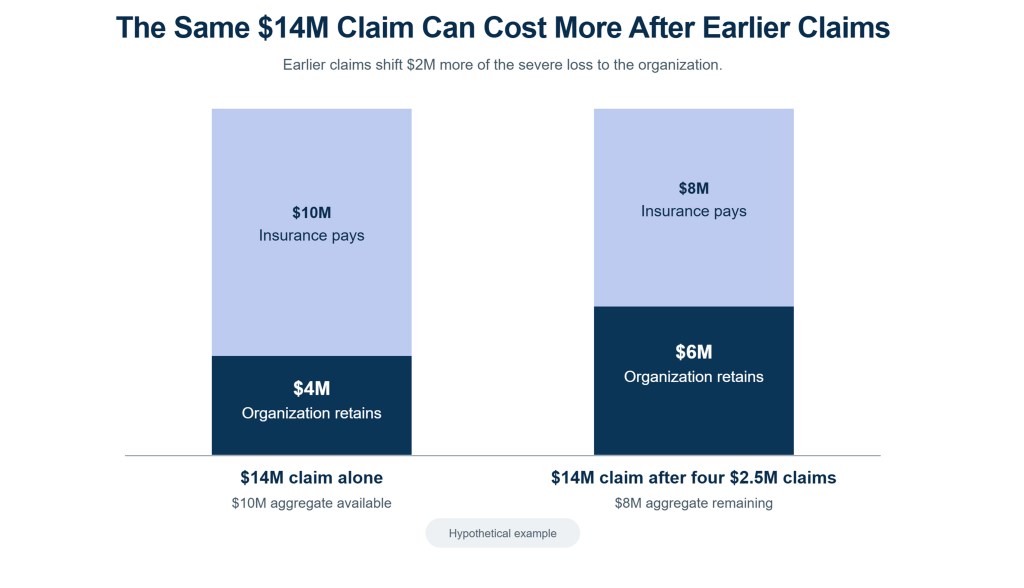
Now a $14 million claim arrives. On its own, the organization would bear $4 million. But after four earlier claims have already drawn on the annual aggregate, only $8 million of excess protection remains. The organization therefore bears $6 million of the severe claim and $14 million across the full policy year. The claim is the same, but the amount of protection available when it occurs has changed.
Read the full in-depth article
More Claims Are Reaching Higher Layers
MagMutual analyzed more than 36,000 claims from hospital submission data, comparing claims resolved from 2017 through 2022 with those resolved from 2023 through 2025. Overall claim volume was relatively stable, but the distribution and severity of losses changed.
The proportion of closed claims exceeding $5 million approximately doubled in the more recent period. Among claims that crossed the $1 million threshold, the average amount above that threshold increased by approximately 33%, while average ground-up severity, measured as indemnity and expense, rose by 48%.
These findings should be viewed as directional rather than predictive. Large claims take longer to resolve, so the more recent period may understate how many will ultimately reach the higher layers. The findings describe trends across the analyzed claims and do not predict any individual healthcare organization’s experience. But the shift raises an important planning question: How would your liability program perform if several significant claims and an unusually severe loss occurred in the same policy year?
Stress-Test the Full Claim Year
Stress-testing the same structure across different claim scenarios can reveal outcomes a single large-loss scenario may miss. An expected year establishes a baseline. Other scenarios can test the effects of repeated retained losses, an unusually severe claim or a combination of the two.
The goal is not to predict which scenario will occur. It is to understand the range of financial outcomes your current structure could produce.
Evaluate More Than Your Limits
Those potential outcomes should inform a broader renewal discussion. Claims experience is only one reason to reassess the liability insurance program. Changes in the organization’s exposure can alter the risk being retained, while shifts in financial position, capital priorities or tolerance for variability can change how much loss the organization is prepared to absorb.
At your next renewal:
- Quantify cumulative retained loss. Model the total your organization could retain across a full policy year, not only the cost of the largest claim.
- Test the aggregate under pressure. Determine how much protection remains if several significant claims occur before a severe loss.
- Update your exposure profile. Account for acquisitions, new facilities, service line changes and shifts in specialty mix that may have altered your exposure since the program was structured.
- Align the structure with your financial objectives. Confirm that the range of potential outcomes fits your capital priorities and tolerance for financial variability.
These are capital and balance sheet questions as much as insurance questions. The goal is not necessarily to buy more coverage or retain less risk. It is to make a deliberate decision about how much financial variability the organization can absorb and where insurance should respond.
Know What Your Balance Sheet Could Face
A liability program can perform exactly as designed and still produce a financial outcome leadership did not anticipate. Understanding how retained loss, insurance and claim timing interact can give finance and risk leaders a clearer view of what the balance sheet could face.
In the example above, the organization retains $8 million across four claims. Those losses are not necessarily paid in the year the claims occur. Large claims can take years to resolve, so the cash impact may spread across several budget cycles. Finance and risk leaders can model both the size and timing of retained losses by starting with the expected payout pattern at each retention level, then testing how a severe loss would fall into that schedule.
Read the full article, “Is Your Liability Insurance Program Built for a Difficult Claim Year?” to see how one illustrative liability structure performs across four claim scenarios. MagMutual’s Capital Solutions team brings experience managing more than $1 billion in risk to help healthcare organizations make informed risk financing decisions.
Gabriela Campanella is Head of Capital Solutions, MagMutual Insurance Company.
About MagMutual
For more than four decades, MagMutual has provided medical professional liability insurance to healthcare professionals and organizations. Today, MagMutual is the largest mutual medical professional liability insurer in the U.S., serving more than 50,000 healthcare professionals and organizations nationwide.*
*Market position based on S&P Global Market Intelligence 2025 year-end financial filings.
The scenarios discussed are hypothetical and illustrate an evaluation method only. Retention and limit amounts do not represent typical terms or recommendations. Trend observations describe a book of business and do not predict any individual organization’s experience. Coverage availability may vary by state; contact your agent for more information.
The information provided in this article does not constitute legal, financial or other professional advice. Consult your own advisers before making decisions based on this content.
